- Sections :
- Crime & Public Safety
- Restaurants & Food
- Sports
- More


I often say that “Texas defends America.” That’s a shorthand reference to our state’s proud, ongoing contributions to the U.S. military and our national defense.
But in the years after Texas joined the Union in 1845, the equation was usually reversed. Mexico and three major Indian tribes were considered threats, so the federal government sent cavalry troops to protect Texas and its settlers.
One group of U.S. Army forts was set up along the Mexico border. Another group was built to safeguard travelers west of San Antonio, especially those pursuing gold in California starting in 1848.
Texas’s population increased ten-fold during the 40 years after statehood, fueled by a desire for land and a nationwide demand for beef cattle. The determination of the Native Americans to protect their territory and way of life was a major challenge for American army troops and Texas Rangers during the last half of the 19th century.
“The two ways of life were incompatible,” a historian writes in The Texas Experience. “The Plains Indians depended on buffalo for sustenance and required large numbers of free-ranging herds,” while the Anglos “sought buffalo for profit and land for settlement.”
The Army eventually constructed some 40 forts in central and west Texas and along trails leading westward to El Paso. Following the Civil War, a string of frontier army posts were established to keep order along the northwest frontier—from Fort Worth through Abilene and San Angelo—and protect ranchers, cowboys and other settlers from the Comanche and Kiowa.
Fort Richardson was built near Jacksboro, northwest of Fort Worth, in 1868. It soon became the largest federal military facility in the United States, with nearly 700 active duty cavalrymen and officers.
That era was over quickly. Battles with Indian chiefs Quanah Parker of the Comanches and Victorio of the Apaches soon spelled the end of the Indian Wars in Texas. The forts— Richardson, Griffin, Chadbourne, Concho, and McKavett—were largely abandoned by 1883.
Disappearing with them was the Wild West frontier ethos dramatized later in western movies and novels. The “Flats” community outside Fort Griffin, near present-day Albany, Texas, was as rowdy as any. For a few brief years, it attracted colorful characters from both sides of the law—among them Wyatt Earp, Doc Holliday, Bat Masterson, John Wesley Hardin and the “Gambling Queen” Lottie Deno.
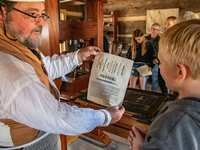
As they tamed the frontier, however, soldiers mostly brought along civilization. They built roads, surveyed land, stretched telegraph wire, protected cattle drives, supported merchants and supplied health care.
“The soldiers had spent most of their time not chasing Indians or outlaws but building habitable places to live in an often inhospitable environment. They had made significant contributions to Texas’s growth. In return, many had been struck by the land, the opportunity and the spirit of independence that still gripped the one time republic,” writes historian Robert Wooster.
Some of these patches of military-created civilization disappeared entirely into history. Others are now state historical sites, at least partially restored and well worth a visit. Still others evolved into thriving towns and cities, like Fort Worth, Fort Davis and Fort Stockton.
Today, as it combats terrorism and other threats worldwide, the U.S. military remains a major presence in Texas. We have 15 major bases, and the largest ones—Fort Bliss in El Paso and Fort Hood near Killeen—rank among the most vital staging areas in the war on terror.
Technology is far different than in the 19th century, but one factor remains as true today as it was then: Texans appreciate our military. We strongly support our men and women in uniform as they carry out their mission to defend our country.
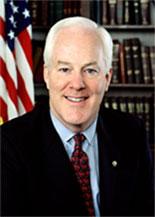
Sen. Cornyn serves on the Armed Services, Judiciary and Budget Committees. In addition, he is Vice Chairman of the Senate Select Committee on Ethics. He serves as the top Republican on the Judiciary Committee’s Immigration, Border Security and Refugees subcommittee and the Armed Services Committee’s Airland subcommittee. Cornyn served previously as Texas Attorney General, Texas Supreme Court Justice and Bexar County District Judge.