- Sections :
- Crime & Public Safety
- Restaurants & Food
- Sports
- More
Formerly incarcerated men find hope for a better tomorrow at Lone Star College System


HOUSTON, TX -- Joseph “Smitty” Smith was determined to find a job to support his family. But after spending nearly 30 years in prison, he found himself with an 11th-grade education, no work experience and no knowledge of modern technology.
Shortly after being released from prison and moving into the CrossWalk Center residential re-entry program in 2017, Smith was connected to a stable job at Refined Technologies (RTI), a Houston-based global solutions provider where about 5% of the full-time workforce has spent time in prison and now maintains RTI’s mechanical rental fleet.
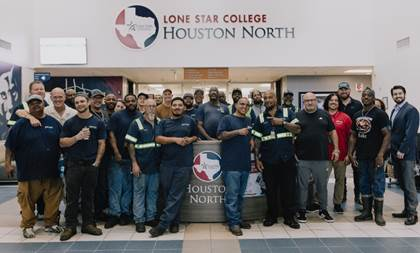
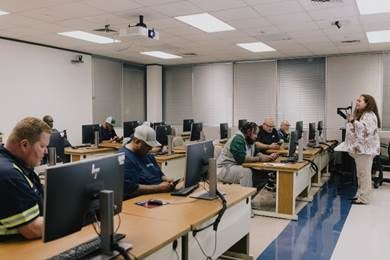
Smith and about 30 of his RTI colleagues started learning basic computer skills at Lone Star College System this March and are working toward earning a Microsoft Excel Associate Certification by the end of the summer. The classes are free to students and funded by a federal grant.
“For the first time in my life, I’m looking forward to going to school,” Smith said. “There are a lot of reasons why I want to see this through, but most of all because I’m going to better myself.”
The Adult Education and Literacy program at LSCS primarily consists of ESOL and GED classes, but also offers intensive services for about 145 students annually. This includes immigrants with post-secondary degrees from outside the country looking for work locally, employers seeking to upskill their teams and individuals who have been released from the prison system.
“Students who have been in jail for a while typically haven't been afforded any opportunities to develop computer skills,” said Connor O’Sullivan, LSCS executive director, Adult Education. “Some of them missed the entire adoption of the internet. They know they need to catch up, but don’t have the resources to do it themselves. Expecting them to conduct a modern job search without any further guidance is like expecting them to do a backflip.”
Ruben Ramos spent nearly half of his life in prison and is learning to operate computers for the first time at age 60.
“I had some anxiety going in, but the teacher was enthusiastic and excited to help us,” Ramos said. “She didn’t say, ‘Some of y’all aren’t going to make it’—she said we’re all going to do good.”
According to the Prison Policy Institute, about 600,000 Americans transition out of prison each year, and the unemployment rate for this group is about five times larger than the general population. Additionally, roughly 44% are re-arrested within one year of release due to housing instability, employment challenges, health issues and educational barriers.
In 2018, the men striving to reintegrate into society at the CrossWalk Center needed work, and RTI was struggling with turnover in hourly positions. Cody Nath, RTI CEO and CrossWalk Center co-founder, established a second-chance hiring initiative that has increased retention rates at RTI and given formerly incarcerated individuals a life-changing opportunity to have jobs that bring dignity and pride. This partnership continues today, with 80 second-chance hires working at RTI.
Most of the second-chance hires at RTI are in physically demanding roles that involve handling equipment, which becomes more difficult as they age. Scott Stagis, a supervisor at RTI’s Houston maintenance facilities, wants to see them move up within the company or even find better-paying roles elsewhere. Becoming comfortable working on computers is the next step for those hoping to advance their education or careers.
“It’s encouraging to see hope for a better life. My goal is to get them to continue thinking about how they can develop themselves,” Stagis said. “Now that you know computer skills, you can do online programs and maybe go on to earn a degree or become a supervisor.”
Stagis attempted to coordinate an internal computer class to help the team overcome technological obstacles, but much of the class was spent powering on the computers, getting everyone logged in and launching the website. It didn’t take long for him to realize his staff would need more individualized education.
That’s when local nonprofit leader Josh Walker helped facilitate a partnership between RTI and LSCS. Walker founded a ministry called 7More to give individuals coming out of prison the best chance at success by connecting them with counseling, mentorship, job referrals and other resources.
“Many people have no one meeting them on the day they’re released and have no possessions to their name. Securing employment and housing in a positive environment is a major challenge,” Walker said. “A lot of these men have dreams of degrees, but the thought of setting foot in a college classroom would be completely overwhelming and daunting.”
But when RTI second-chance hires show up for class at LSC-Houston North, they know their instructors and fellow students will support them.
RTI kicks off each workday with team members taking turns leading a devotional and a time to express gratitude. Men getting back on their feet after incarceration often celebrate milestones such as securing a driver’s license, reconciling with a family member, moving out of a halfway house into their first apartment, obtaining a vehicle or maintaining sobriety.
Despite being intimidated by technology, they carry that culture of gratitude, empowerment and encouragement into the classroom as they learn to navigate the taskbar and type on a keyboard.
Students who recently called themselves “tech-illiterate” are now one step closer to being qualified for jobs they wouldn’t be considered for today, pursuing business degrees and helping their grandchildren navigate their own technology devices.
“We appreciate what Lone Star College System is doing for us,” said Devin Burgess, who earned his GED in prison and has worked at RTI since 2022. “It’s very few and far between that somebody would stick out their neck for us. I just enjoy the kindness y’all have shown.”
LSCS offers workforce training and continuing education for individuals and corporate groups, and scholarships are available for many of these opportunities. Learn more at LoneStar.edu/Adult-Education.