- Sections :
- Crime & Public Safety
- Restaurants & Food
- Sports
- More
Emergency management students have hands-on learning opportunities at Lone Star College System


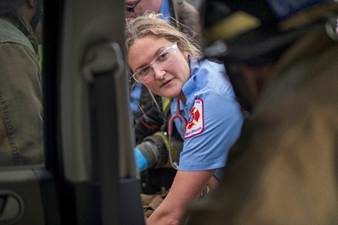
HOUSTON, TX -- Students in Lone Star College System’s Bachelor of Applied Science in Emergency Management program are learning about disaster response in a new way thanks to a partnership with Simental Industries and EM Disaster Gaming.
Arthur J. Simental, DM, CEM, said he founded Simental Industries to help homeland security and emergency management professionals prepare for disasters through wargaming—a popular tactic used by the military and defense sectors for centuries.
“I’ve also created EM Disaster Gaming so that first responders, emergency managers, policymakers and disaster workers can use this as an opportunity for more immersive and engaging training and education,” Simental said. “I hope to challenge them to think critically, strategize, communicate, cooperate and better plan for disasters through more robust tabletop exercises, modeling and simulation.”
The game’s format is similar to Dungeons & Dragons, a popular cooperative tabletop role-playing game. In EM Disaster Gaming, students respond to disasters and whims of fate as determined by dice rolls, chance cards and other probability mechanics. EM Disaster Gaming makes a variety of physical games and has a virtual platform that covers a series of disasters, from hurricanes and transportation incidents to pandemics and terrorist attacks.
“At Lone Star College System, we are always looking for ways to innovate and ensure our curriculum is up to date,” said Laura Gehrig, Ph.D., LSCS department chair, BAS Emergency Management. “Disaster wargaming allows students to engage in their classwork in a more meaningful way, responding to simulated disasters on the spot.”
LSCS students in the BAS Emergency Management program take courses such as Hazard Mitigation and Preparedness, Infrastructure Systems and Disaster, Emergency Management Planning, Disaster Response and Recovery, and Risk and Crisis Communications.
These classes prepare graduates like Brett Shryock to confidently enter or advance in the workforce. Shryock was one of the first students to enroll in the BAS program after obtaining an associate degree in fire science from LSC-CyFair. Since graduating, he has been promoted from a logistics specialist to a logistics supervisor at the Harris County Office of Homeland Security & Emergency Management.
“I wouldn’t change it for the world,” Shryock said. “I had matured a lot as the years went on, so I looked at the classes differently than I would have at age 18 or 19. Bringing that experience to the classes really helped. I got to give a lot of feedback and share my experience with classmates, and I learned a lot from the professors.”
Many students in the program are already actively working as first responders. Some are pursuing a bachelor’s degree to access additional stipends at work, while others hope to advance their careers or have an alternate pathway lined up once they’re ready to move on from the more physically demanding frontline roles.
Emergency managers must have excellent organizational and project management skills as they make crucial logistical decisions amid disasters. Gehrig said this degree program allows students to create stability for their families and have job security in a high-demand field.
Learn more at LoneStar.edu/Programs-Of-Study/Emergency-Management.