- Sections :
- Crime & Public Safety
- Restaurants & Food
- Sports
- More
Categories


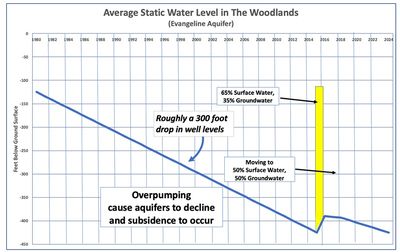
AVERAGE STATIC WELL LEVELS IN THE WOODLANDS 1990 - 2024
TH WOODLANDS, TX -- Montgomery County is, or soon will be, facing critical water issues, largely due to the County’s rapid growth and inadequate planning. As a hint of things to come, Conroe imposed a temporary moratorium, that lasted one year, on new construction permits in defined areas due to a strained water supply.
Most of the County’s water – about 80 percent – comes from groundwater pumping. The natural recharge rate for water drawn from the County’s three principal aquifers – the Jasper, Chicot, and the Evangeline ¬– is about 65,000-70,000 acre-feet per year. (One acre-foot equals covering an acre of land by one foot.) Currently, over 115,000 acre-feet of water (including unregulated wells) is being withdrawn annually. As a result, aquifer levels are declining and, along with it, well levels. Since the year 1990, well levels in the Evangeline aquifer, alone, have dropped from 100 to over 400 or more feet. The simplified trend of static well levels that draw water from the Evangeline aquifer in The Woodlands since 1990 is shown below.
Most other water wells in the County are also experiencing declines in static water levels.
After the San Jacinto River Authority (SJRA) began distributing surface water in 2015, reducing groundwater use, well levels in The Woodlands began to recover until increased water demand exceeded the contribution of surface water, in less than two years later, as shown in the graph. The renewed trend of declining well levels is a warning of the dangers ahead.
Declining well levels result in the need to dig expensive replacement wells when old ones run dry or installing more powerful pumps to lower depths (at higher electrical costs). Also, additional new wells are continuing to be drilled to meet ever-growing water needs. The bottom line to syphoning so much water from the aquifers, besides the consequences noted above, are the following damages:
1. Permanent, irreversible compaction of soil due to removal of water, causing the land surface to subside, increasing the susceptibility to flooding and altering drainage patterns
2. Uneven land movement at or near ground faults, causing damage to roads, buildings, pipelines, and structures
3. Loss of aquifer water storage capacity
4. Reduction in soil permeability to absorb surface water where compaction has occurred
In some areas of Montgomery County, the ground surface has sunk by about two feet since the year 2000. This decline in ground levels is continuing. As an extreme example of the dangers of subsidence, the once wealthy community of Brownwood In Harris County sunk by ten feet due to excessive groundwater pumping, destroying the town. It is now nothing more than a wetland.
With no or limited availability to source additional surface water, the Lone Star Groundwater Conservation District (LSGCD), which regulates groundwater pumping, is currently requesting to be allowed to pump up to 199,000 acre-feet of water annually by the year 2080, more than twice its present technical allowance of 97,000 acre-feet per year, or about three times the natural recharge rate. At current County growth rates, even pumping that much groundwater may not be enough. The community has not done enough to address water conservation, recycling wastewater, sourcing additional surface water, or conduct regional water planning.
While LSGCD’s modeling (arguably) suggests that there is enough water in the aquifers to meet future (undefined) demand, Montgomery County cannot continue to escalate groundwater pumping levels very many more years without more severe consequences. It will take years of planning and action to meet growing needs with more surface water. The most glaring issue is that there is no central authority to plan, act, and implement increased sourcing of surface water in the years ahead, whether from Lake Conroe or from other locations. The San Jacinto River Authority (SJRA) can’t do it alone. LSGCD can’t do it alone. Conroe or The Woodlands can’t do it alone. Another voluntary Groundwater Reduction Plan agreement approach is no longer workable.
Montgomery County desperately needs a central governmental authority that involves the whole county with the responsibility, authority, and funding capability to source and distribute additional surface water. Obtaining more water without depleting our aquifers or causing irreversible subsidence problems is a community issue not unlike community needs for education or fire and police protection. The days of pumping more and cheaper groundwater are approaching an end.
Action needs to start with Montgomery County’s Commissioner Court, with input and support from SJRA, LSGCD, other water providers, County communities, local legislators, and the State government. More water, without damaging our present environment is essential to our future. We need to act now before water supply becomes a crisis, similar to that currently being experienced by Corpus Christi.
CENTRAL PLANNING NEED TO SECURE FUTURE WATER SUPPLY
Most of the County’s water – about 80 percent – comes from groundwater pumping. The natural recharge rate for water drawn from the County’s three principal aquifers – the Jasper, Chicot, and the Evangeline ¬– is about 65,000-70,000 acre-feet per year. (One acre-foot equals covering an acre of land by one foot.) Currently, over 115,000 acre-feet of water (including unregulated wells) is being withdrawn annually. As a result, aquifer levels are declining and, along with it, well levels. Since the year 1990, well levels in the Evangeline aquifer, alone, have dropped from 100 to over 400 or more feet. The simplified trend of static well levels that draw water from the Evangeline aquifer in The Woodlands since 1990 is shown below.
Most other water wells in the County are also experiencing declines in static water levels.
After the San Jacinto River Authority (SJRA) began distributing surface water in 2015, reducing groundwater use, well levels in The Woodlands began to recover until increased water demand exceeded the contribution of surface water, in less than two years later, as shown in the graph. The renewed trend of declining well levels is a warning of the dangers ahead.
Declining well levels result in the need to dig expensive replacement wells when old ones run dry or installing more powerful pumps to lower depths (at higher electrical costs). Also, additional new wells are continuing to be drilled to meet ever-growing water needs. The bottom line to syphoning so much water from the aquifers, besides the consequences noted above, are the following damages:
1. Permanent, irreversible compaction of soil due to removal of water, causing the land surface to subside, increasing the susceptibility to flooding and altering drainage patterns
2. Uneven land movement at or near ground faults, causing damage to roads, buildings, pipelines, and structures
3. Loss of aquifer water storage capacity
4. Reduction in soil permeability to absorb surface water where compaction has occurred
In some areas of Montgomery County, the ground surface has sunk by about two feet since the year 2000. This decline in ground levels is continuing. As an extreme example of the dangers of subsidence, the once wealthy community of Brownwood In Harris County sunk by ten feet due to excessive groundwater pumping, destroying the town. It is now nothing more than a wetland.
With no or limited availability to source additional surface water, the Lone Star Groundwater Conservation District (LSGCD), which regulates groundwater pumping, is currently requesting to be allowed to pump up to 199,000 acre-feet of water annually by the year 2080, more than twice its present technical allowance of 97,000 acre-feet per year, or about three times the natural recharge rate. At current County growth rates, even pumping that much groundwater may not be enough. The community has not done enough to address water conservation, recycling wastewater, sourcing additional surface water, or conduct regional water planning.
While LSGCD’s modeling (arguably) suggests that there is enough water in the aquifers to meet future (undefined) demand, Montgomery County cannot continue to escalate groundwater pumping levels very many more years without more severe consequences. It will take years of planning and action to meet growing needs with more surface water. The most glaring issue is that there is no central authority to plan, act, and implement increased sourcing of surface water in the years ahead, whether from Lake Conroe or from other locations. The San Jacinto River Authority (SJRA) can’t do it alone. LSGCD can’t do it alone. Conroe or The Woodlands can’t do it alone. Another voluntary Groundwater Reduction Plan agreement approach is no longer workable.
Montgomery County desperately needs a central governmental authority that involves the whole county with the responsibility, authority, and funding capability to source and distribute additional surface water. Obtaining more water without depleting our aquifers or causing irreversible subsidence problems is a community issue not unlike community needs for education or fire and police protection. The days of pumping more and cheaper groundwater are approaching an end.
Action needs to start with Montgomery County’s Commissioner Court, with input and support from SJRA, LSGCD, other water providers, County communities, local legislators, and the State government. More water, without damaging our present environment is essential to our future. We need to act now before water supply becomes a crisis, similar to that currently being experienced by Corpus Christi.
Comments •