- Sections :
- Crime & Public Safety
- Restaurants & Food
- Sports
- More
How Much Does Roof Replacement Cost In Houston, TX? A 2026 Price Guide For Homeowners


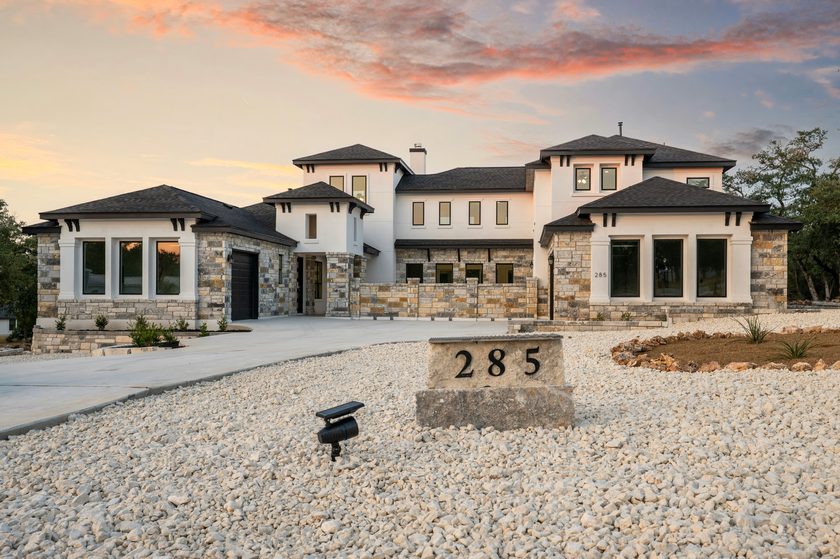
THE WOODLANDS, TX – Houston roof replacement costs $7,500 to $16,500 for most homes in 2026. See prices by roof size and material, what moves the number, and how storm claims pay, according to the owner of Roofing The Woodlands TX.
What follows are real numbers from a roofing company working Montgomery and Harris County roofs: what you should expect to pay, every factor that moves the price, how hurricane and windstorm coverage actually pays, and how to tell a low bid from a bad roof.
The short answer
Most Houston-area homes cost $7,500 to $16,500 to reroof with architectural asphalt shingles in 2026. The average home across Harris, Montgomery and Fort Bend counties carries roughly 2,000 to 2,500 square feet of roof area, measured on the slope rather than off the floor plan, which usually works out to $10,500 to $14,000 installed.
Larger roofs, steep or cut-up designs, and upgraded materials like standing seam metal or tile push the number higher. If a named storm or straight-line wind event caused the damage, your policy may cover most of it.
Houston pricing generally runs below Austin and Dallas for the same scope. Labor is the reason. Central Texas carries a construction labor premium that the Gulf Coast market does not, though that gap narrows sharply in the months after a hurricane when every crew in the region is booked.
Houston Roof Replacement Cost by Roof Size
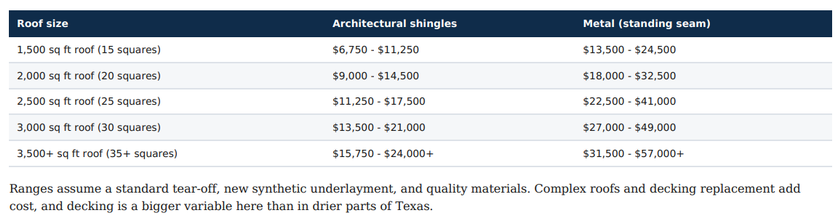
Roofers measure in squares. One square equals 100 square feet of roof surface. Your roof area is always larger than your floor plan because it includes the pitch, the overhangs, and every separate plane, so a 2,000 square foot house usually carries 2,200 to 2,800 square feet of roof.
Here is what full replacement typically costs across the Houston metro in 2026, tear-off included:
Cost by house size
Most homeowners know their house square footage, not their roof square footage. Here is the crosswalk, assuming a typical 5:12 to 6:12 pitch with standard overhangs:
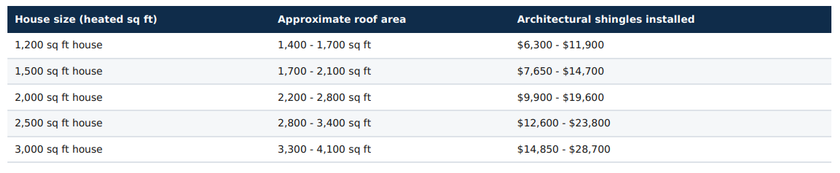
A steeper pitch pushes roof area toward the top of each range and adds labor on top of that. A single story ranch with a simple gable lands near the bottom. A two story home with multiple gables, dormers and a wraparound porch lands near the top or above it.
For national context, the typical US roof replacement runs $6,000 to $18,000 depending on region and material, with Gulf Coast pricing sitting near the middle of that band. Labor rates and permit costs account for most of the regional spread.
Cost by Roofing Material
Material is the second largest price lever after size. On the Gulf Coast it is also a wind and moisture decision rather than a hail decision, which changes what makes sense compared to Central Texas.
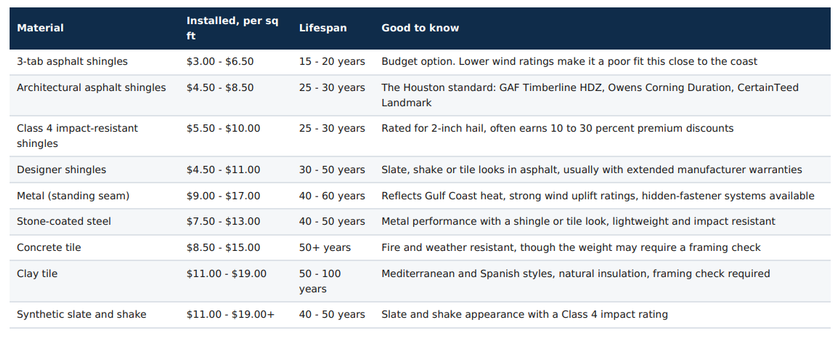
For most Houston homeowners, architectural asphalt shingles installed to a high-wind fastening pattern give the best balance of cost, performance and appearance. If you plan to stay long term, standing seam metal is worth pricing out. Its wind uplift performance is the strongest of anything on this list, and the cost per year of service usually lands below shingles despite the higher ticket.
One note specific to this market: shingle wind ratings matter more here than shingle impact ratings. A Class 4 impact rating is built for hail. What holds a roof together during a tropical system is the wind rating and the fastening pattern behind it.
How Insurance Changes the Equation
If wind, hail or a fallen tree damaged your roof, your policy may cover most of the replacement. Along the Gulf Coast this is the most common way homeowners fund a new roof. Four policy details decide what you actually pay.
Named storm and hurricane deductibles. Most Texas policies carry a separate wind and hail deductible calculated as a percentage of dwelling coverage rather than a flat dollar figure. Many Houston-area policies go a step further and apply a distinct named storm or hurricane deductible that triggers only when the National Weather Service names the system.
On a home insured for $400,000, a 1 percent deductible is $4,000 and a 2 percent deductible is $8,000. That can be more than half the cost of the roof, and it is enough to change whether filing makes sense at all. Read your declarations page before hurricane season and ask your agent specifically whether the named storm deductible is separate from the standard wind and hail deductible.
RCV vs ACV. Replacement Cost Value pays today's price minus your deductible. On a $13,000 replacement with a $4,000 deductible, the carrier covers $9,000. Actual Cash Value subtracts depreciation for the roof's age first, so the same $13,000 claim on a 12-year-old roof might pay $6,000 to $8,000. ACV policies carry lower premiums, which is why they get sold, and they pay considerably less at claim time. Check which one you have while you still have the option to change it.
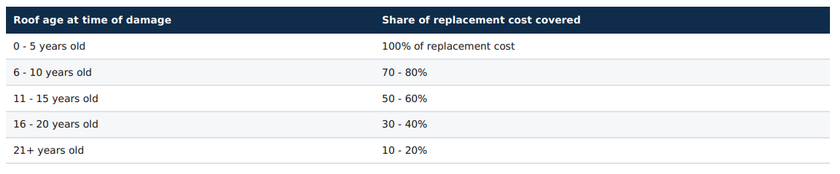
Roof age payment schedules. Some newer Texas policies pay on a sliding scale tied to the roof's age at the time of damage:
Windstorm coverage and TWIA. Standard carriers write wind coverage across most of Harris, Montgomery and Fort Bend counties. Closer to the coast, and in the portion of Harris County east of State Highway 146, windstorm coverage may run through the Texas Windstorm Insurance Association instead, which carries its own inspection and certification requirements for new roofs. If your address falls in that zone, confirm the certification path with your contractor before work begins, because retrofitting documentation afterward is difficult.
One legal note that applies statewide: it is illegal in Texas for a contractor to offer to waive, absorb or rebate your deductible. If anyone makes that offer, that tells you what you need to know about the rest of their operation.
How to Save Money on a Roof Replacement
Compare at least three written estimates line by line. The lowest total is not the best value if it skips underlayment, downgrades the fastening pattern, or omits ventilation. Compare the checklist items above, not the totals.
Ask about wind mitigation discounts. Many Texas carriers discount premiums for documented wind-resistant construction, and some recognize the IBHS FORTIFIED Roof standard. Class 4 impact-resistant shingles commonly earn 10 to 30 percent off the wind and hail portion of the premium. Both require documentation at the time of installation, so raise it before the job starts rather than after.
Do not schedule into a storm surge. The two months after a landfalling hurricane are the worst time to buy a roof in this market. Demand spikes, out-of-state crews flood the region, and pricing firms up. Winter and early spring are the calmer windows.
Do not wait too long either. A failing roof that keeps leaking adds interior damage, mold remediation and decking replacement to the bill. In this climate, decking rot compounds faster than most homeowners expect. Replacing on your schedule instead of during an emergency is itself a discount.
Choosing the Right Roofing Contractor
Texas does not license roofing contractors at the state level, so vetting falls to you. After every major storm, out-of-state crews move into affected neighborhoods within days.
Proof of insurance and certifications. Ask for current general liability and workers' compensation certificates, and check manufacturer certifications like GAF, which require vetted installation standards and unlock enhanced warranties.
A local track record. An established local address, years of completed work in the area, and references from recent projects near your home. Storm chasers do fast cheap work and are gone before the first warranty question comes up.
Written, itemized estimates after an in-person inspection. Be cautious of anyone quoting from satellite imagery or over the phone.
Real warranties. Material warranties run 10 to 50 years depending on the product. Workmanship warranties from established contractors run 5 to 10 years or more.
Photo documentation. Before and after photos of each line item give you verifiable proof that the materials you paid for went on the roof, and a record if a warranty question surfaces in three years.
No pressure. A contractor who needs a signature today, a large deposit up front, or who offers to cover your deductible is telling you how the rest of the job will go.
Houston Roof Cost Questions, Answered
What does roof replacement cost per square foot in Houston?
Installed architectural shingle roofs across the Houston metro typically run $4.50 to $8.50 per square foot of roof area in 2026. Standing seam metal runs roughly $9 to $17, and tile runs $8.50 to $19 depending on concrete or clay. Because roofers price by the square, you may also hear this quoted as $450 to $850 per square for architectural shingles.
How much does it cost to replace a roof on a 2,000 square foot house?
A 2,000 square foot house typically carries 2,200 to 2,800 square feet of roof once pitch and overhangs are counted. At Houston-area architectural shingle pricing that works out to roughly $9,900 to $19,600 installed, with most projects landing between $11,000 and $15,000. Pitch, the number of planes, and decking condition account for most of the spread.
How much does roof replacement cost per square?
Roofers price by the square, meaning 100 square feet of roof surface. Architectural shingles run roughly $450 to $850 per square installed in this market. Standing seam metal runs $900 to $1,700 per square. Multiply by your square count for a rough total, then adjust upward for steep pitch and complexity.
Why is Houston cheaper than Austin or Dallas for the same roof?
Labor. Central Texas carries a construction labor premium that the Gulf Coast does not, and labor is 40 to 50 percent of a roofing total. The gap closes in the months following a hurricane, when regional crew availability tightens and pricing firms up across the market.
Is a metal roof worth the extra cost on the Gulf Coast?
For many homeowners, yes. Metal costs roughly twice as much as architectural shingles up front, but it lasts 40 to 60 years against 25 to 30, reflects heat for lower cooling bills, and carries the strongest wind uplift ratings available in residential roofing. If you plan to stay long term, the cost per year of service usually lands below shingles.
Do I need a permit to replace my roof in Houston?
It depends on your jurisdiction. The City of Houston, unincorporated Harris County, Montgomery County and each incorporated suburb handle residential reroofing differently. Budget $150 to $500 and have your contractor confirm and pull whatever applies at your address. If a contractor suggests skipping the permit where one is required, treat that as a serious warning.
What is a named storm deductible and how is it different from wind and hail?
A wind and hail deductible applies to any wind or hail loss. A named storm or hurricane deductible applies only when the National Weather Service has named the system. Many Houston-area policies carry both, at different percentages. Since these are calculated against dwelling coverage rather than as flat dollar amounts, the difference between a 1 and 2 percent deductible on a $400,000 home is $4,000. Check the declarations page before hurricane season.
What is the difference between RCV and ACV coverage?
Replacement Cost Value pays to replace your roof at current prices minus your deductible. Actual Cash Value subtracts depreciation for the roof's age first, so a 12-year-old roof might be depreciated 40 percent and leave you covering the gap. ACV policies carry cheaper premiums and pay considerably less on a roof claim.
Will insurance cover my roof replacement?
If the damage came from a covered event such as hurricane wind, straight-line wind or hail, insurance typically pays for replacement minus your deductible, subject to your policy's RCV or ACV structure and any roof age schedule. Age and normal wear are not covered.
Does a roof estimate cost anything?
No. We provide free inspections and free written estimates with exact pricing for your specific roof. There is no obligation.
How Roofs Fail Here: Hurricane Wind on the Gulf Coast, Hail in Central Texas
Cost is one half of the question. What actually damages a roof is the other half, and it is not the same across Texas.
Drive 150 miles west and roofers are looking for something completely different when they climb a ladder. Montgomery County sits in a hurricane path. Central Texas sits in a hail corridor. The storms are different, the damage is different, and the way that damage is found and inspected is different too. That last part is what catches homeowners off guard, and it is a large part of why a Houston roof claim can be harder to get paid than an Austin one.
Hurricane and wind damage to a roof in the Houston area
A tropical system is not an event so much as a siege. Sustained wind pushes at a roof for hours, then pushes again from the opposite direction as the system passes.
Broken seal strips and lifted shingles
Damage can start with improper installation. When nails are driven too high or outside the manufacturer's designated nail zone, the shingle may not have the wind resistance it was designed to provide. A shingle that has not properly sealed along the adhesive strip is also more vulnerable when high winds arrive.
Blown-off or missing shingles are easy to notice from the street, but some of the more difficult wind damage to identify is hidden. Wind gets underneath a shingle and breaks the seal strip bonding it to the course below. Once that seal is broken, the shingle settles back down and looks completely normal from the driveway, even though it is no longer sealed or performing as intended.
“By the time you can see it from your yard, it's been leaking into your roof's decking for a while,” said Chris Arevalo, owner of Austin Roofing Company, whose crews have worked roofs in both markets since 2008. “We pull back shingles on the windward edge and the seal is just gone. Nothing looks wrong from thirty feet away.”
Wind-driven rain and rotted decking
Then the rain arrives. Rain driven sideways for hours pushes under lifted shingles and past displaced shingles into the decking, corroding the nails and eventually opening a path for water beneath the shingles.
Unlike Central Texas, roofs here rarely dry out. Gulf Coast humidity keeps moisture in the decking long enough to rot it, which is why decking replacement is a line item on so many Houston-area projects and a rarity on Austin ones.
You may not notice the leak right away. Roof decking absorbs and holds moisture before water ever becomes visible inside the home. As exposure continues and the decking saturates, moisture eventually makes its way through to the ceiling below. In many cases that yellow or brown ceiling stain is the first visible warning, even though the roof had been taking on water well before the stain appeared.
“In Austin we're mostly swapping shingles,” said Chris Arevalo, whose Montgomery County crews now operate as Roofing The Woodlands TX. “Here we're pulling rotted deck a lot more often.”
Debris punctures
Debris is the third factor. Branches, fence sections and neighbors' shingles puncture rather than bruise, and those punctures usually leak the fastest of any damage on the roof.
What hail damage looks like on a roof in Central Texas
Hail is the Austin problem, and the contrast explains why the two markets inspect so differently.
Hail hits the open surface, the part roofers call the field, along with the hips and ridges. It fractures the mat under the shingle and can break the plastic vents on the roof system. Granules break loose and wash into the gutters or collect around the home's perimeter.
Signs of hail damage on shingles
The damage is spread fairly evenly, an inspector can chalk a test square and count strikes, and most of it is visible from the roof the same afternoon. Look for dark bruised spots where granules are missing, soft indentations that give slightly under thumb pressure, and a line of granule buildup at the downspout outlets.
Hail shortens a roof's life more than it breaks it open. Water gets in eventually through bruised mat and exposed asphalt, but usually over seasons rather than days.
What size hail damages a roof
Pea and marble sized hail rarely damages asphalt shingles. Damage typically begins around one inch, roughly quarter sized, and
becomes consistent at 1.25 inches and above. Wind speed matters as much as stone size, since wind-driven hail striking at an angle concentrates force on the exposed portion of the shingle.
That is the practical split. Hail is an impact loss that happens in minutes and is not normally visible from the street. Hurricane and wind damage covers a much wider spectrum. Some of it is obvious, and some of it stays hidden until the next storm turns it into a bigger problem.
When to get a storm damage roof inspection
Timing is the real problem in this market.
Hail claims get filed fast because the damage is obvious to an adjuster. Wind and water claims often get filed late, after a ceiling stain shows up weeks or months after the storm. The later a claim is filed, the harder it is to win, because carriers push back when the date of loss and the date of discovery are far apart.
So after a named storm, get the roof inspected even if it looks fine from the ground. A dated inspection photo report establishes the loss date whether or not you end up filing.
Filing a storm damage roof insurance claim in Texas
The deductible math above decides whether filing makes sense. The documentation decides whether it gets paid.
What holds up: a dated photo report from a professional inspection, a storm report tied to your specific address, and interior photos of any ceiling or attic staining with dates attached. What does not hold up: a verbal description of damage weeks after the fact, or a claim filed after a second storm has muddied which event caused what.
Under Texas law it is illegal for a contractor to offer to waive your deductible, and accepting that offer can create problems on your own claim, not just the contractor's.
What to do after storm roof damage
-
Photograph the roof from the ground on all four sides now, before the next storm. A dated before image is the most useful thing in a disputed claim.
-
After a windstorm, look at the entire roof, or as much of it as you can see from the ground.
-
Check attic decking and ceilings after the storm and again a few weeks later, not just the day after.
-
Get a professional inspection photo report in writing, along with a storm report for your address, whether you file or not.
-
Read your declarations page before hurricane season and confirm whether a named storm deductible applies separately.
Get Your Exact Number, Free
Ranges are useful. Your roof is specific. We will inspect it, measure it, and hand you a written itemized estimate with the fastening pattern, the decking allowance and the warranty terms spelled out. No cost, no obligation.