- Sections :
- Crime & Public Safety
- Restaurants & Food
- Sports
- More


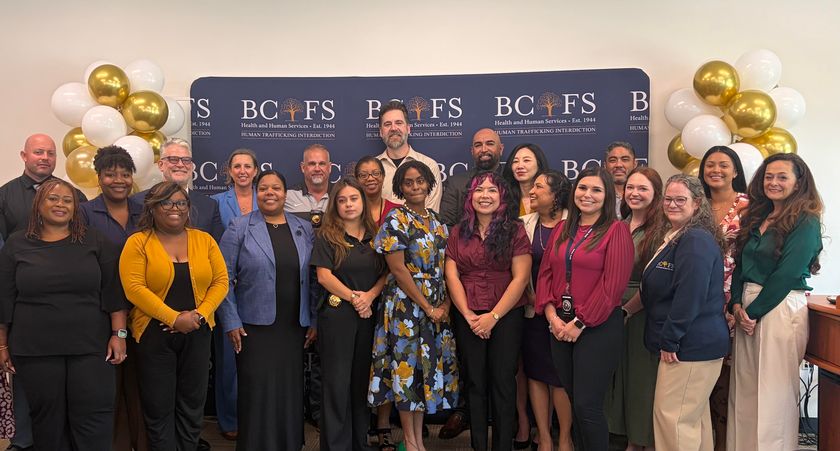
CONROE, TX -- The scene at the Conroe Police Department this past Thursday involved many agencies with a presence in Montgomery County, each with its intent to stop human trafficking not only within the boundaries of MOCO, but across the State of Texas. Founded in San Antonio in 1944, formerly Baptist Children and Family Services, BCFS Health and Human Services’ mission is to protect children and women from harm in regards to being human trafficked and from being used sexually in internet crimes. BCFS was on hand to host the first Southeast Texas launch event of Montgomery County’s Commercially Sexually Exploited Youth (CSEY) Program. All children, no matter the case, should be loved and properly cared for, but that is not the case for a section of children who are taken advantage of sexually or trafficked. Overall 19 agencies are involved in MOCO’s effort in Building Bridges Against Trafficking (B-BAT), which implemented the Texas Model for Care Coordination for victims of trafficking and the sexually exploited, aiming to foster coordination between agencies to offer the best services for care and gather information for law enforcement and prosecutors to use in trying cases providing justice to those hurt in traumatic episodes.
The Program Supervisor for B-BAT Montgomery County, Lannie Higgins, introduced several speakers during the launch event of which she and her team have been preparing for in the past year, learning from the BCFS and its National Director Iris Resendez, who leads the Human Trafficking Prevention and Response Team, headquartered in San Antonio. Higgins explained Montgomery County’s CSEY Care Coordination Program introduction to the community of partners and recognized the collaborative efforts of its community partners who work to provide the crucial services and needed care for the youth and young adults who are at risk, or impacted by commercial sexual exploitation.
“The program is designed to provide proactive, trauma-responsive interventions,” said Resendez. “And to ensure the youth receive timely access to services, resources, and support tailored to their individual needs.”
Higgins went on to describe the goals of the Care Coordination Program, along with the importance of a coordinated community response, and the role participating agencies will play in strengthening services for youth and young adult victims in Montgomery County.
Funded by the Texas Governor’s office, The County’s CSEY Care Coordination Program follows the Texas Model for Care Coordination. It brings together community partners, law enforcement, the district attorney’s office and service providers to coordinate support for vulnerable youth and young adults. Appointed by Governor Abbott, Janet Law Michalik, is the Administrator for the Public Safety Office’s Child Sex Trafficking Team.
Michalik's team works closely with Montgomery County’s CSEY program as one of the partner agencies. She has lived and worked in MOCO for many years, growing up here, and is a former county social worker handling cases of homelessness in their different phases. She joined the CST Team in 2018, as it was just being created, birthed from legislation from 2015, and she soon obtained the role of Regional Advisor, with her placement in Houston. Ms. Michalik’s aim was to expand her program to Montgomery County, then Covid hit, and the program creation kept being delayed. As her team’s role began expanding, they realized that the number of children who showed signs of abuse or were at risk for being abused.
“They’re kids who aren’t confirmed victims yet,” said Michalik. “Law enforcement hasn't opened an investigation, and what we learned is that kids who are experiencing this type of victimization don't recognize it and outcry. And it takes a lot of support, and interventions for them to be able to see their victimization.”
Key B-BAT members of Montgomery County are the District Attorney’s Office and Precinct 3 Constable’s Ryan Gable’s Office, with his office’s electronic mission to combat Child Sexual Abuse Material (CSAM), online solicitation of minors, and human trafficking. The team is headed by Captain Adam Acosta, of the Criminal Investigations Division. The Pct. 3 Constables actively target online exploitation, perfectly emulating teenage girls, targeting adult predators with major issues in desiring children when they should be seeking help.
“We have assigned six full-time detectives to this work in particular,” said Acosta in reference to CSAM and ICAC capabilities. “We also have other resources within our patrol division that help us out when needed.”
Acosta also spoke on activities which coordinated events to apprehend suspects during operations associated with the June FIFA World Cup games in Houston. Those ops were the victims first involvement with law enforcement, and the encounter started their care coordination in victims of human trafficking.
“We spent months planning this operation, since October 2025, all the way leading up to June,” said Acosta. “We coordinated with you law enforcement operations, the state, local providers, as well as federal partners. We put a plan together, we implemented it, and we had some great results.”
Now with the BCFS Health and Human Services Common Thread program and other capabilities, the care coordination of the victims has been streamlined, reducing the amount of hoops that Acosta’s team will have to jump through in organizing day-to-day, and special operations. The Captain also mentioned Hands of Justice, a survivor-led Montgomery County organization committed to providing support and guidance through lived experience experts, peer support specialists, and advocates that provide support services. Together with the partnership of licensed trauma therapists, they ensure their participants have access to professional mental health resources. Hands of Justice offers hope, support, and pathways to healing for survivors of human trafficking, most notably in overlooked suburban and rural communities where trafficking is prevalent and remains unseen.
Incredibly, many victims of human trafficking see themselves as in trouble, and initially are unresponsive to law enforcement.
“We have to take them from that mentality of being in trouble to one that they're victims,” said Acosta. “So we team them with an organization under the BCFS banner, so they can get resources or at least offered resources that they can accept to get out of that lifestyle.”
During operations in June, it was noted that they were able to apprehend 61 offenders and file 79 charges, while recovering 28 victims of human trafficking. Acosta mentioned Our Rescue, an NGO that was on the ground with the interdiction team that took down the traffickers. Previously known as Operation Underground Railroad, Our Rescue works to combat human trafficking and child sexual exploitation through field operations, survivor support, and training and prevention programs.
On the Montgomery County District Attorney’s side, ADA Chris Seufert, is the Chief of Internet Crimes Against Children and Human Trafficking (ICAC-HT), and leads a team that works with MOCO Police Departments, Texas DPS, MOCO Constable Offices, as well as Homeland Security Investigations. They take the results of undercover chat sting operations, online solicitation, and the analysis of seized digital and physical evidence, putting together approximately 120 felony cases annually involving the possession of CSAM and online luring evidence.
From Seufert’s point-of-view, following law enforcement operations, and getting the victims into a proper care program, it’s his team’s responsibility to get the victim ready to testify. Which is why care coordination is so important in providing stability for the victim to be able to answer questions from both the defense and prosecutorial sides during the trial phase.
“If we are going to have a successful prosecution, when it comes to the exploitation of young people, you're going to need to wrap those victims in services,” said ADA Seufert, who has been at his position for nearly 20 years. “What I do in the courtroom, what we do getting ready is not going to be enough to give those kids the justice they need, so we have to work together.”
Essentially, Captain Acosta’s team bags the bad guys, while Seufert’s team tags them.
“If I can't bring that evidence into court, then ultimately we're not going to be able to get justice for the victim,” said Seufert. “The process is burdensome for the victims, and if they stop cooperating, and decide it would be better for them not to cooperate, then we're not going to be able to get the case across the finish line.”
Those cases are unfortunate, and even with a great investigation, they can turn into a fragile argument if the victims are not wrapped in the services offered. What care coordination does for the prosecution, is that it contributes to providing stability for the child involved in the case. Generally in a case, the prosecutor might meet with the child three to four times.
“The meetings are designed to build bonds and develop a good working relationship,” said Seufert. “And that's just not going to be enough for that child to feel like they're being taken care of by the system , but care coordination fills that missing gap.”
The ADA went on to say that the organizations associated with BCFS HHS, are most helpful in getting the child feeling connected to the process. The victim advocates that deal with Seufert’s office are able to answer the questions about the process, and if they can’t, the District Attorney’s office right there to get the answers that are needed. Seufert’s team works to have the child victims testify, whether the case goes to trial or not, but the process does not end once the case is closed. The aim is shepherding those children in the program to go from a victim to a survivor.
Montgomery County is fortunate to have three commercially sexually exploited youth advocate agencies, and under the BCFS umbrella they will be able to work together as a cohesive community for the better future of children in the region.
BCFS HHS: bcfshhs.org
TX Department of Family and Protective Services: dfps.texas.gov
DA’s Email: DA.Info@mctx.org
ICAC Tip Line: 936-760-6910
By: Ruben Borjas, Jr., Columnist, Montgomery County News