- Sections :
- Crime & Public Safety
- Restaurants & Food
- Sports
- More


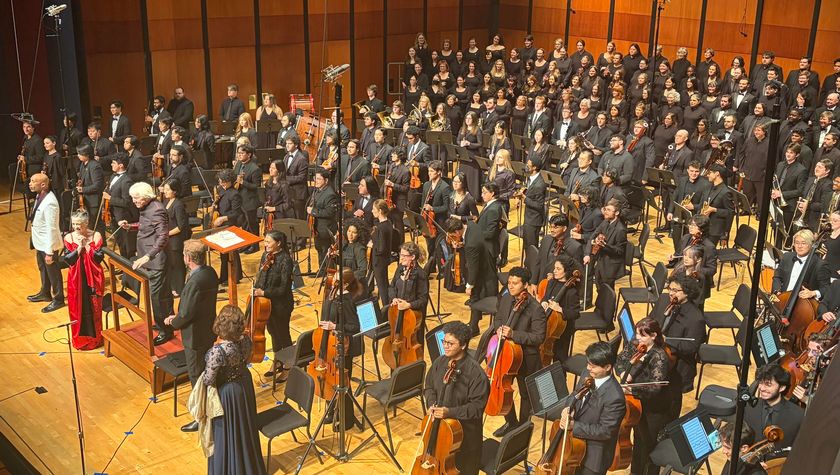
HOUSTON, TX -- It’s a piece of work that would be welcomed with a volunteer orchestra in rural Africa, and no matter what continent it’s played on, the significance of His 9th Symphony can be overwhelming, with its meaning of universal brotherhood, the humanity of man, plus its triumphant theme of joy over mankind’s despair. The University of Houston’s Moores Opera House, starting its 30th year, played host to Ludwig van Beethoven’s most treasured work this past Saturday evening, its first performance on-campus in twenty-two years, as well as being the first sell-out ever for the house. The Moores School Symphony Orchestra, led by Conductor Frank Krager, and the Chorale and Chorus led by Director Anthony Maglione, proved that a risk can pay off, with the vast majority of their crews who had never taken part in an official performance of the music written by a deaf man, who could hear the majesty of its product in his mind.
The Moores Opera House is a cozy theater. It’s a bit smaller than, but modeled after the traditional houses of Europe for goers to enjoy the near same acoustics that music lovers in the past would have felt. And being a student orchestra, it is interesting to see the amount of iPads that now display the digitized sheet music of the great master, as opposed to the actual paper still favored by several students.
From the word ‘go’ Krager’s players commanded the stage, and they knew it, even with the start of the First Movement (Allegro ma non troppo), of which symphony goers of May 1824 were shocked when no firecrackers were heard, only to be greeted by a landscape full of primal nothingness. It’s a fifth free of mood by the horns then encroached upon by the celli and second violins with their tense and repetitive notes, which was perhaps Beethoven's way of presenting his swan song, that ‘this one is gonna be different, so listen up,’ while at the same time causing nervous tension amongst the listeners. Then the pizzicato notes of the cellos and bases yields to that so important motif, ‘ba-ba, ba-ba’ that builds to the rising crescendo of the first full orchestral outburst of a massive storm of the main theme in D minor. It grabs your attention, then retreats, as if it was written by a battlefield commander, using deception to confuse an enemy, or listeners in this case, which more than likely was His intent. It’s like Beethoven is asking the listener to defer to his deference, to yield to his submission and trust him, which the public at the time loved, but the critics took a while to accept; and the same can be said of those critical of Albert Einstein and his theories, or Vincent Van Gogh and his masterpieces. The message of the first movement as set by the unique opening is to expect the unexpected with the tiny fugue that presents itself, the trade offs between the woodwinds, and the pulling back of the reins on moments that appear to have taken off with full force. It’s the beginning of the change of music that The World never expected, but thankfully was gifted to us by the genius of Beethoven, and finishing the first movement for the orchestra had to be a definite confidence booster for the Cougar players.
In the Second Movement (Molto vicace) Beethoven expands the fifth from before to an octave and opens the second much like he ended the first, with a memorable and powerful rhythm that we all know and love so well. The placement of the scherzo, another screwball thrown into the mix of breaking traditions, generally reserved for the third movement puts the jest in motion with multiple variations on the theme that slowly builds the lively dance portion of the program with intensity. Following an accelerando, a trio is placed following a snapped-off variation, possibly, but with the 9th, anything is in play. The shifting of a number of three instrument sections gives an idea of a rustic mountain scene, and a greater wanting to be expanded upon before the return of the scherzo with a few more variations, before even that is cut off with a short reprise of the trio then the hammer drops, and it's done.
In thinking on Beethoven’s strategy here, some can see him as a sort of process manager, developing the ideas and processes that benefit all parties in the output. He knows down the line, intensity is gonna build close to breaking point, so he slows down with his Third Movement (Agadio molto e cantabile). The flipped movements allow for some rest for his players on a soothing musical couch if you will, which allows for peaceful contemplation in B-flat major. Some may feel a pastoral scene follow a few measures with playful wildlife enjoying life with their brethren interacting with the flowers, grasses, or hovering insects; still others may envision themselves sauntering under a glorious canopy of trees embracing the majesty of nature, and the inner peace it allows one on which to reflect in internal prayer never to be spoken. The lead horn player was masterful in his endeavor, and most certainly earned the credit for the representation of the glorious nature of the movement, along with the strings and woodwinds. It brings to mind the incredible heralded brass that would have inspired Beethoven’s pen in those moments of reflection of what was taken in, as well as the multiple goodbyes to nature it took before the light would give way and he eventually had to turn his back to the scene.
Ah, the finale. The Fourth Movement (Ode to Joy). The Presto. The beginnings of that chaotic flourish of madness, of horror, with the trumpets and timpani, answered by the celli and basses with their insistent insertions. Then recitatives hold the key to the beginnings of the ode, rejecting the themes of prior movements that present themselves as if saying ‘remember me?’ The fifth from the first, a small lower volume snip of the rhythmic Scherzo in the second, then a prayer-like serene offering from the third. It all leads to a number of ideas that center on the listener themselves, the remembrance of past days, or their personal failures or successes, the hope for a happy future, the sentiments that we expressed or withheld over the years. It’s really the genius of the piece, allowing the listener a bit of personal ownership in the production itself, and the control of their own destiny. The intimacy of the orchestra’s low instruments at the beginning of the ode, as quiet as the moment before a newborn takes its first breath, before ramping up to that melody we all know and love, and in a way mimicking the voices to come. The reprise of the more aptly named terror fanfare, or Presto, yields to the bass-baritone of Timothy Jones retreating the orchestra with "O Freunde, nicht diese Töne!" ("O friends, not these sounds!"), and yields to the beginnings of the invitation to share Friedrich Schiller’s famous poem with the chorus on celebrating the brotherhood of man.
It was a triumphant night for the The Moores School Symphony Orchestra, the UH Concert Chorale, and the Houston Symphony Chorus; and in reality, no performance of Beethoven’s 9th Symphony has ever sounded exactly the same, giving way to a unique UH experience. The other featured soloists, Cynthia Clayton (soprano), Zachary Averyt (tenor), and Melanie Sonnenberg (mezzo-soprano), all did their part in representing the moment when the vocal and orchestral worlds collided to forever change music. It was the perfect performance on the perfect night, and the prolonged standing ovation was well deserved.

By: Ruben Borjas, Jr., Columnist, Montgomery County News