- Sections :
- Crime & Public Safety
- Restaurants & Food
- Sports
- More
Lone Star College System trains students for high-demand ASL interpreter careers


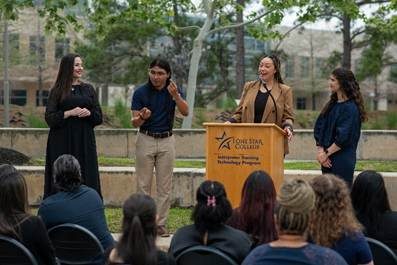
HOUSTON, TX -- Approximately 500,000 Americans rely on American Sign Language (ASL) to communicate, according to the National Census of the Deaf Population.
But with just 10,000 certified interpreters in all of North America, demand for qualified interpreters is high across the medical, public service, legal and education sectors, among other industries. Lone Star College System offers an Associate of Applied Science in Interpreter Training Technology to help fill this workforce gap.
Candace Sexton-Ruiz, LSC-North Harris chair, American Sign Language Department, said students today are increasingly seeking online learning and career opportunities, but interpreting is most effective in a face-to-face setting. Although technological advancements have made transcription tools more helpful and accessible, in-person interpreters are still needed for flexible, fulfilling and high-paying careers in the field.
“It’s not just what you say but how you say it,” Sexton-Ruiz said. “AI can’t detect tone or emotions. There will always be a need for interpreters.”
Sexton-Ruiz said a few of her students, like Sebrina Lorenz, have connections to the deaf community, and some were inspired by school-based interpreters who assisted their classmates growing up. Many took an ASL class as a fun elective and fell in love with the language and community.
“There are so many benefits,” Lorenz said. “Learning ASL has helped me be able to communicate better. I didn’t always have the tools, so I decided to learn about the tools rather than just watching off to the side.”
Lorenz is deaf and has relied on lipreading for most of her life. Taking ASL classes at LSC-North Harris has made her feel more empowered in her own communication and helped her better support her son, who is deaf.
September is Deaf Awareness Month, and International Week of Deaf People 2026 is Sept. 21-27, highlighting the community’s vital contributions, celebrating deaf culture and shining a light on the need for inclusive policies.
Before the Americans with Disabilities Act became law in 1990, career options for deaf individuals were extremely limited. Communication access, barriers to education, accommodations and job opportunities have improved over time, but there is still work to be done in these areas. Both Sexton-Ruiz and Lorenz have struggled to find work at times due to their disability.
“As Dr. I. King Jordan, the first deaf president of Gallaudet University, once said, ‘Deaf people can do anything hearing people can do, except hear,’” Sexton-Ruiz said. “We just need the right accommodations and tools.”
The ADA also required businesses, government offices, medical providers and schools to ensure deaf and hard-of-hearing individuals had access to effective communication, including providing a qualified ASL interpreter at no cost to the individual.
LSCS is equipping future interpreters to serve this community with passion, excellence and specialized skills. Learn more about the Interpreter Training Technology program at LoneStar.edu/Programs-Of-Study/Interpreter-Training-AAS.