- Categories :
- More
Nigiri vs. Sashimi vs. Sushi: A Simple Guide
By:
 Benihana
| Published 03/30/2026
Benihana
| Published 03/30/2026


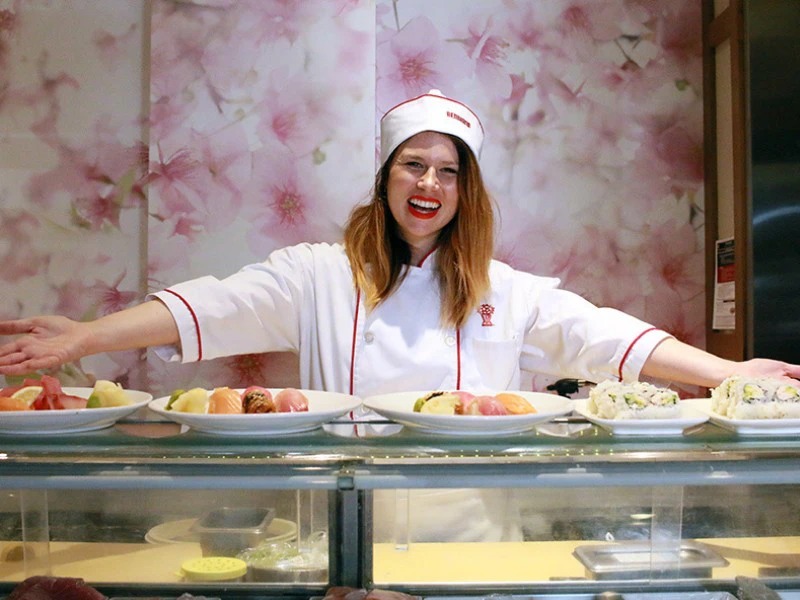
If you’ve ever sat down at the sushi bar and quietly wondered, “Wait… which one is nigiri and which one is sashimi again?” you’re in good company. At Benihana, those little details matter just as much as the big birthday song, the sizzle from the grill, and the chef making everyone at the table laugh.
Think of this as your friendly warm up before you dive into the story below. In a few quick paragraphs, you’ll get clear on what sushi, nigiri, and sashimi actually are, which ones come with rice, which are simply fresh, raw fish, and how to choose the style that fits what you’re craving that day. Then you’ll head right into the sushi bar at Benihana Santa Anita, where one of our chefs shows exactly how it all comes together in real life.
This post is sponsored by Benihana. All opinions are my own.
When I got invited back into my local Benihana in Santa Anita to learn about making sushi rolls and the difference between sashimi and nigiri from one of their seasoned professional sushi chefs (Andy), I was obviously beyond excited! I also felt honored, as I know that chefs in training have to put in numerous hours before being able to even attempt to cut a beautiful piece of fish into sashimi or nigiri, and I was going to get to after less than an hour of getting acquainted with the sushi bar.
Learning to Roll a California Roll
First up – seaweed paper, sushi rice, sesame seeds, krab, avocado, and cucumber – the California Roll.
Fun fact: the California Roll was first served in the 1960s at a restaurant in Los Angeles.
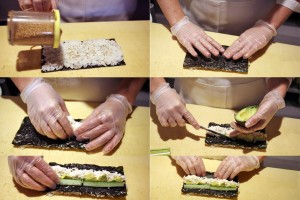
- Grab a handful of rice, about the size of a medium avocado, place on the left side of the seaweed paper. Use fingertips to spread the rice out evenly on the paper, as gently as possible.
- Shake sesame seeds onto rice.
- Carefully flip the rice-covered seaweed over so the rice is down on the surface.
- Grab about an ounce of krab and distribute in the middle of the seaweed paper (from left to right).
Pro Tip: all of these steps should be done from left to right
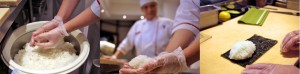
- Use a dull knife to cut pieces from an avocado half and place next to the krab.
- Place 2 slivers of cucumber next to the avocado.
- From the long side closest to you, very meticulously and quickly roll up the California roll, tucking one end into itself. This was one of the hardest parts of the day for me! Thankfully you can clean it up visually in the next step!
- Use sushi-rolling mat (makisu) to shape the roll more evenly. Also fix each end, while still using the mat, by exposing each end, then tapping with your fingers.
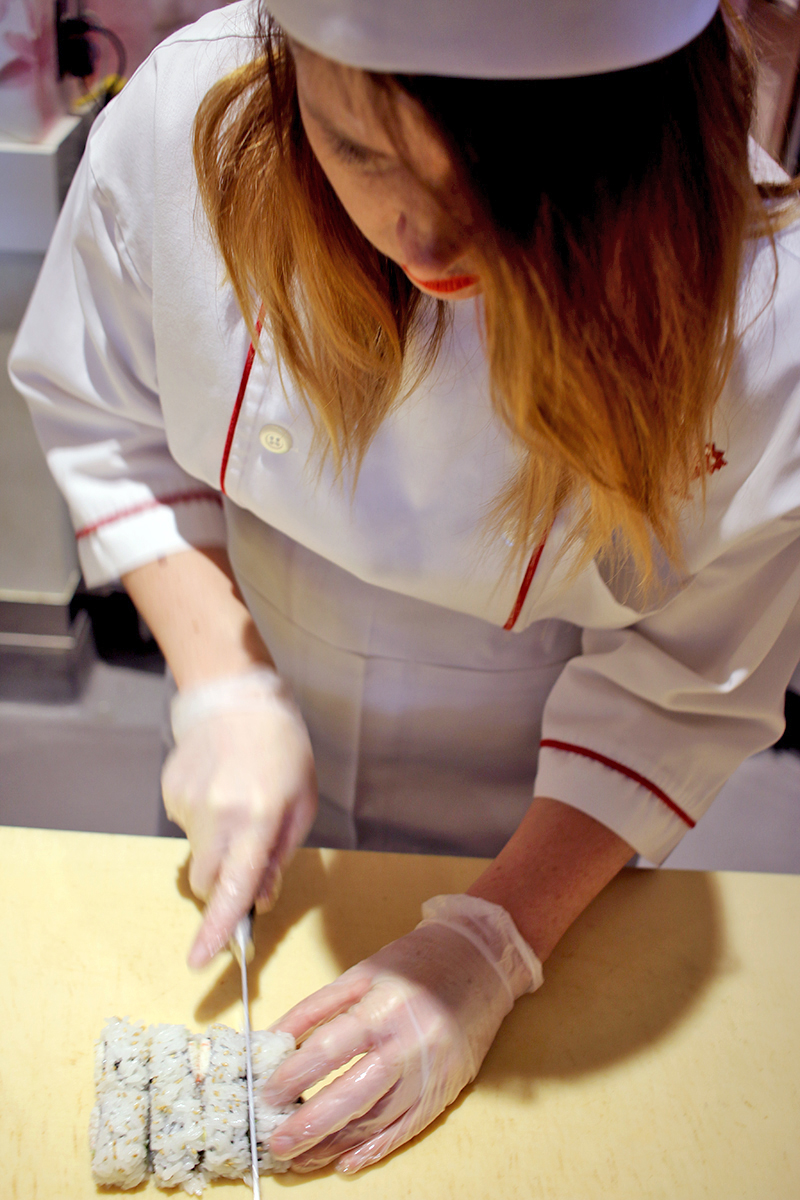
- Remove mat. Grab a knife and dip the tip in water, then point the tip up so the water runs down the knife. (This helps the knife not stick to the roll as much in the next step.)
- Cut roll in half with a sawing motion. Flip one half to line up with the other half then cut in half again.
- Plate beautifully!
Benihana Note: Sushi, Nigiri and Sashimi Explained
 Before Andy moved on from rolls to those beautiful pieces of fish you see on the menu, we like to pause and share a few basics from the Benihana side. For our chefs, sushi isn’t just a line on the menu – it’s a craft they practice for years, and understanding the different styles makes sitting at the sushi bar feel a lot more fun and a lot less intimidating. Here’s our quick version:
- Sushi is the big umbrella. Any time our seasoned sushi rice is the base of the dish – in a roll, in a hand‑formed piece, or in a combination platter – you’re enjoying sushi.
- Nigiri is that small, hand‑pressed bite of rice with a slice of fish or seafood resting neatly on top. We design it to be one clean, satisfying bite.
- Sashimi skips the rice completely. It’s all about thin, clean slices of fish or seafood, so you can really focus on texture, temperature, and freshness.
Guests who like things light and high in protein often start with sashimi. If you want that signature Benihana sushi rice in the mix, nigiri – or a mix of nigiri and rolls – is usually the way to go.
Hands-On with Sashimi and Nigiri
Next up! Ever looked at the menu at the sushi restaurant and wondered what the difference between sashimi and nigiri is, even after you know you’ve asked and / or looked it up half a dozen times? I learned the difference and how to cut and assemble both.
I honestly can’t easily put into words the beautifully precise way Andy taught me how to slice the fish. But I can tell you the difference between sashimi and nigiri and the simple assembly steps for both. Sashimi is a fresh slice of raw fish, and nigiri is a fresh slice of raw fish, atop a ball of sushi rice. I decided that the best way to remember is to think about Sashimi being solo (sans rice).
Firstly, start off by slicing the fish meticulously (the video shows a bit of technique). Then swipe a tiny bit of wasabi on the back of it, where the ball of sushi rice will be placed. Form a small ball of sushi rice where the fish slice will be placed. I definitely did not master Andy’s technique of placing the fish onto the ball of rice. It sounds simple enough, huh? It sure is not; he wraps the fish so perfectly around the rice in a way that was difficult to master in just a few tries! I am going to have to practice this one at home! I sliced salmon, yellowtail and tuna which all were prepared as I explained above.
The eel is the only one that doesn’t get wasabi and received a little band of seaweed (nori) around it and the rice, topped off with eel sauce. My favorite! Both the sashimi and nigiri plates are finished off with a mountain of ginger and wasabi. Andy told me that the art of making sushi is based on creating rivers and mountains, so that you will notice these shapes. You create the mountains with the ginger and wasabi alongside the beautiful cuts of fish.
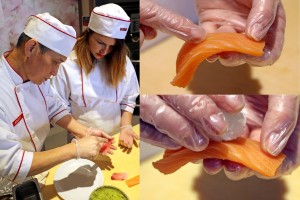
Meet Chef Andy
I ended up asking Andy about his background. He moved here from Japan and has been practicing sushi for about 19 years. He shared with me that he had suffered a stroke a few years back that changed his life for the better, as he begun to care more about his health and lifestyle. I honestly would never have known. It was beautiful how passionate he is about his creations and how he was able to get through a roadblock and improve his life after a difficult event.
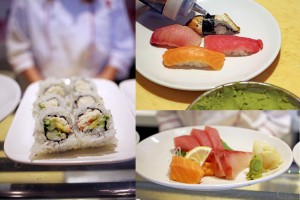
I ended up asking Andy about his background. He moved here from Japan and has been practicing sushi for about 19 years. He shared with me that he had suffered a stroke a few years back that changed his life for the better, as he begun to care more about his health and lifestyle. I honestly would never have known. It was beautiful how passionate he is about his creations and how he was able to get through a roadblock and improve his life after a difficult event.
At the end of Andy’s lessons, I asked him what his tips are for people just getting into making sushi!
He said, “Watching, asking, doing.” And to be gentle and take your time. I think a lot of us could use that advice in our everyday life while learning new skills and approaching tasks. Hey, I think it could even be applied to our personal lives and relationships. Who knew that I would go to Benihana to learn about sushi and come out with a life lesson!
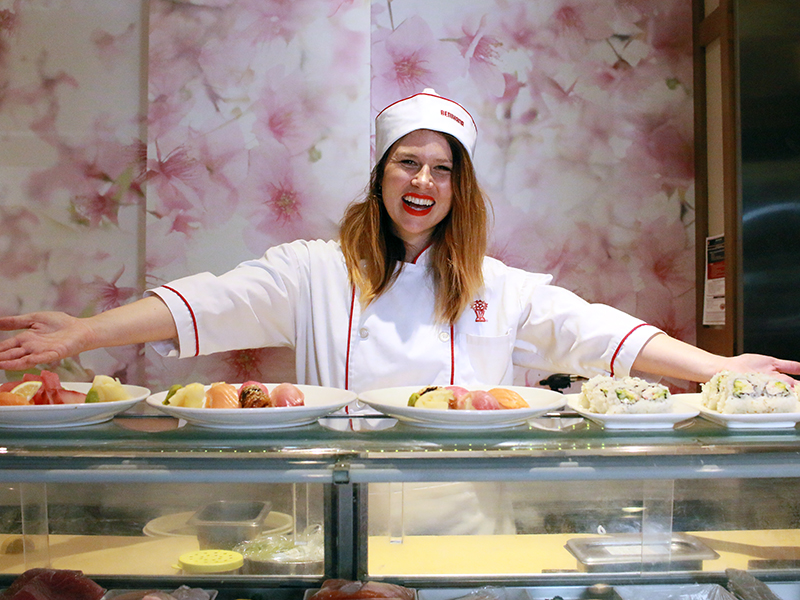
If learning from Andy has you curious about trying it yourself, explore our Benihana sushi experiences,like Be the Chef and our Sushi & Sake or family sushi classes. Where guests can step behind the counter and create their own rolls and nigiri with guidance from our chefs.
Nigiri vs. Sashimi vs. Sushi: FAQs
What is the difference between nigiri and sashimi?
At Benihana, we treat nigiri and sashimi as two distinct experiences. Nigiri is a small, hand‑formed pillow of our vinegared sushi rice topped with fish or seafood, crafted to be one perfect bite. Sashimi leaves the rice behind and focuses purely on thin, delicate slices of fish, so guests can enjoy the flavor and texture on their own.
Does nigiri have rice?
Yes. Rice is at the heart of nigiri. Our chefs carefully shape a bite‑size mound of seasoned sushi rice, then place the topping on top so every mouthful brings together the warmth of the rice and the cool, fresh fish.
Is nigiri just sashimi with rice?
Not quite. Sashimi is simply sliced fish. With nigiri, the rice is seasoned, shaped, and balanced with the topping on purpose – the temperature, texture, and a touch of wasabi all work together. It’s a small detail, but it’s exactly the kind our chefs obsess over.
What is the raw fish on rice called?
When you see raw fish resting on top of a small mound of vinegared rice at Benihana, you’re looking at nigiri sushi. It’s one of the simplest ways to taste the harmony between our sushi rice and fresh fish.
Which is healthier, nigiri or sashimi?
Both can be smart choices, but they offer different things. Sashimi is usually the lightest option because it’s only fish – high in protein, with no rice at all. Nigiri still brings plenty of protein from the fish, with a modest amount of rice to make the bite more filling.
Is nigiri supposed to be eaten in one bite?
Yes. Our chefs shape nigiri to be enjoyed in a single bite, so you experience the balance of rice, fish, and seasoning all at once. It’s one small