- Categories :
- More
Traveling with Kids Under a Texas Custody Order
By:
 Griffin & Cain, Attorneys at Law, PC
| Published 06/17/2026
Griffin & Cain, Attorneys at Law, PC
| Published 06/17/2026


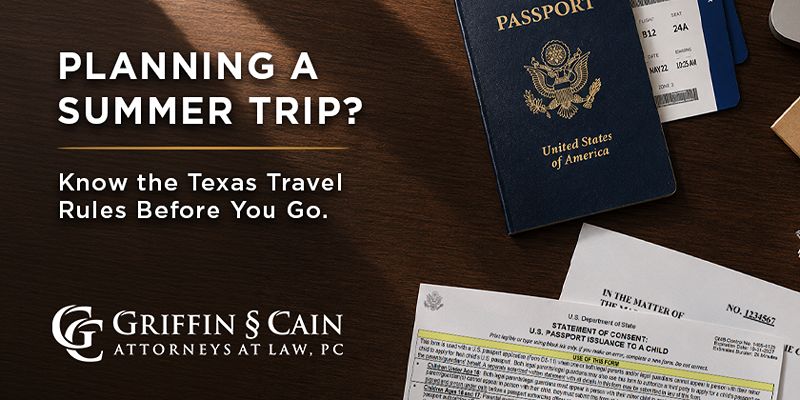
Summer is when most families travel — vacations, visits to out-of-state grandparents, family reunions, and international trips. But if you share custody of your children under a Texas court order, your travel plans are not as simple as booking a flight. Taking your child across state lines or out of the country without proper authorization can trigger an enforcement action, a custody modification, or in extreme cases, criminal charges for custodial interference.
At Griffin & Cain, Attorneys at Law, our family law attorneys in Conroe help parents navigate summer travel questions every year. If you are planning to travel with your child this summer and you are unsure what your order allows, call us at (936) 441-2999 before you go.
What Does Your Court Order Say About Travel?
The first and most important step is to read your actual court order. Not what you remember it saying. Not what your ex told you it says. The actual signed document.
Texas custody orders vary widely in how they address travel. Some orders contain a geographic restriction on the child’s primary residence — limiting the custodial parent to a specific county or school district. Others include specific provisions about out-of-state or international travel, requiring advance written notice to the other parent. Some are silent on travel altogether, which creates its own set of risks.
A geographic restriction on the child’s residence does not necessarily prevent travel during your possession periods. You can typically take your child on vacation to another state during your court-ordered possession time without violating the geographic restriction. The restriction governs where the child lives — not where you can take them for a week at the beach. However, some orders include explicit language about travel notifications or prohibitions, so read yours carefully.
Out-of-State Travel During Your Possession Period
If it is your court-ordered weekend, holiday, or summer possession period, you generally have the right to travel with your child within the United States without the other parent’s permission — unless your order specifically requires advance notice or consent for out-of-state travel.
That said, best practice is always to notify the other parent in advance, provide an itinerary with dates, destinations, and lodging information, leave a phone number where you can be reached, and ensure the child is returned on time per the court order.
Failing to return the child on time — even by a few hours — is a violation of the possession order. If you are flying and your return flight is delayed, document the delay immediately (airline confirmation, weather reports, gate agent communication) and notify your co-parent in writing. Late returns are the single most common enforcement complaint we see in Montgomery County family courts.
International Travel: The Passport Problem
International travel introduces additional legal requirements that many parents do not anticipate until they are standing at the passport office.
Passport applications for children under 16
Under federal law (22 CFR §51.28), both parents must consent to a passport application for a child under 16. This means both parents must appear in person at the passport acceptance facility, or the applying parent must submit a notarized statement of consent (Form DS-3053) from the non-applying parent.
If the other parent refuses to consent, you cannot simply apply without them. You must either obtain a court order specifically authorizing the passport issuance, or file an emergency motion with the family court requesting that the judge authorize the passport over the other parent’s objection.
In our experience, Montgomery County judges will grant passport orders when the traveling parent can show the trip is legitimate (family visit, educational trip, vacation with specific dates), the traveling parent has a track record of compliance with the custody order, and there is no credible risk of international abduction.
The Hague Convention and abduction prevention
Texas Family Code §153.501–§153.503 contains specific provisions designed to prevent international child abduction. If the court determines there is a credible risk that a parent might take the child to a foreign country and not return, the court can order the child’s passport surrendered to the court, prohibit travel to specific countries, require a bond before international travel, and appoint a third party to supervise the child’s travel.
The Hague Convention on the Civil Aspects of International Child Abduction provides a legal framework for recovering children who have been wrongfully taken to or retained in a foreign country. However, it only applies between signatory nations — and not all countries are signatories. If you are concerned about your co-parent taking your child to a non-Hague country, this is an urgent legal issue that requires immediate court intervention.
What If the Other Parent Takes Your Child Without Permission?
If the other parent takes your child out of state or out of the country during your possession period, without your consent, and refuses to return the child, you have several options. For domestic travel, contact your attorney immediately to file a Motion to Enforce and potentially a writ of habeas corpus compelling the return of the child. If the child has been taken across state lines, the Uniform Child Custody Jurisdiction and Enforcement Act (UCCJEA) provides mechanisms for enforcement across state lines.
For international travel, contact your attorney and the U.S. Department of State’s Office of Children’s Issues at 1-888-407-4747. If the country is a Hague Convention signatory, formal return proceedings can be initiated through the Central Authority of the country where the child is being held.
Under the three strikes visitation law, repeated interference with custody — including withholding a child during the other parent’s possession time — can result in criminal charges. International abduction can result in federal felony charges under the International Parental Kidnapping Crime Act (18 U.S.C. §1204).
Practical Steps Before You Travel This Summer
Review your court order and confirm that travel during your possession period is permitted. If your order requires advance notice, provide it in writing at least 30 days before departure. Provide the other parent with a detailed itinerary, including flight numbers, hotel addresses, and emergency contact information. If traveling internationally, ensure your child has a valid passport with both parents’ consent — and bring a certified copy of your custody order with you. Keep your child’s return date sacred and build in a buffer for travel delays. Document everything — emails, texts, and receipts — in case a dispute arises after you return.
If you need help interpreting your custody order’s travel provisions, or if you need a court order authorizing a passport or international travel, call Griffin & Cain at (936) 441-2999. We help parents in Montgomery County, Walker County, and The Woodlands plan their summer travel within the boundaries of their court orders — so they can focus on making memories instead of managing conflict.