- Categories :
- More
Washing Machine Stuck on Wash Cycle? Causes, Fixes & When to Call
By:
 GIR Appliance
| Published 07/07/2026
GIR Appliance
| Published 07/07/2026


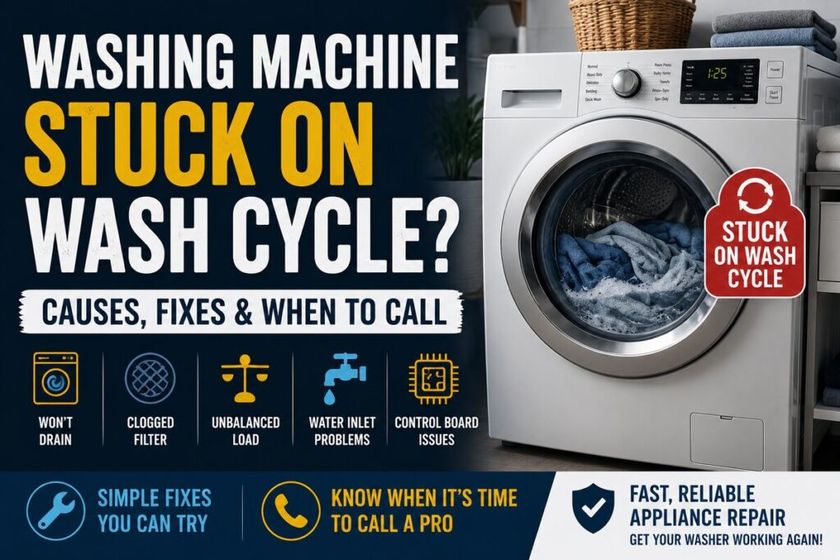
You load the washer, start a cycle, and walk away — but when you come back an hour later, the machine is still sitting on the wash cycle, going nowhere. The drum might be agitating, water might be sitting in the tub, or the machine might just be frozen with the timer stuck. This is one of the most frustrating washer problems because you can not always tell whether to wait it out or call for help.
This guide covers the 6 most common reasons a washing machine gets stuck on the wash cycle, step-by-step fixes you can try, and when to call a professional. GIR Appliance Repair serves The Woodlands, Spring, Kingwood, and Humble TX — call us at (346) 625-4289 for same-day washer repair.
Why Does a Washing Machine Get Stuck on the Wash Cycle?
Modern washing machines — both top-loaders and front-loaders — use electronic control boards to manage every step of the wash cycle: fill, agitate, drain, spin, and rinse. When the machine gets stuck, it means the control system is waiting for a condition that never gets met, or a component has failed and the cycle cannot advance.
The stuck cycle problem is more common in electronic machines (post-2010 models) than in older mechanical-timer machines, because digital controls have more complex logic with more failure points. However, both machine types can experience this problem for different reasons.
Cause 1 — Lid Switch or Door Latch Failure
For top-loading washers, the lid switch is one of the most common causes of a machine that stops mid-cycle and refuses to advance. The lid switch tells the control board whether the lid is closed. If the switch is faulty, the machine thinks the lid is open even when it is not — and it will not agitate, spin, or advance the cycle as a safety measure.
How to check:
- Open and firmly close the lid. Listen for a distinct click.
- With the lid closed, does the motor hum but nothing move? Or is it completely silent?
- If you press down on the lid firmly while in cycle, does anything change?
For front-loaders:
Front-loading washers have a door latch assembly with an electronic door lock. If the door lock fails to engage or disengage properly, the machine will pause the cycle and display an error code (usually a door lock error like F/dL, E1, or similar). The machine will not proceed until the door is registered as locked.
Lid switch and door latch repair is one of our most common washer services. Parts are typically $50–$120 and the repair is straightforward.
Cause 2 — Water Inlet Valve Clog or Failure
The water inlet valve controls the flow of hot and cold water into the machine. If the valve is partially clogged with mineral deposits (very common in The Woodlands area, where groundwater has elevated mineral content) or the valve solenoid has failed, the machine takes much longer than normal to fill — or stops filling entirely.
When the machine is waiting for the tub to reach the set water level and the water never arrives, the cycle stays frozen at the fill or wash step. You may hear the machine humming or clicking but see no water entering.
Quick check:
Turn off the machine and check the inlet hose screens at the back of the washer. These small mesh screens catch debris and mineral scale. If they are clogged, cleaning them may restore water flow. If the valve solenoid itself has failed, the valve needs replacement ($80–$180).
Cause 3 — Water Level Pressure Switch Issue
The water level pressure switch (also called the water level sensor) monitors how full the tub is and signals the control board when the tub has reached the selected water level. When this switch malfunctions, the machine may think the tub is never full — and it will keep waiting in the fill phase, stuck on wash.
Symptoms of a bad pressure switch include:
- Machine fills and fills without stopping (overfilling)
- Machine thinks it is full when it is empty (won’t fill at all)
- Machine gets stuck at the beginning of the wash cycle with water already in the tub
The pressure switch connects to the tub via a small air hose. Sometimes the hose becomes kinked or disconnected rather than the switch itself failing — check that the hose is clear and properly connected before replacing the switch. Switch replacement typically costs $80–$150.
Cause 4 — Timer or Control Board Failure
In older mechanical-timer machines, the timer itself can fail, leaving the cycle permanently stuck at one position. In modern electronic machines, the main control board (also called the PCB or electronic control) is the brain of the operation. When it fails, the machine may:
- Freeze at one point in the cycle and never advance
- Display random or incorrect error codes
- Start but stop after a few minutes
- Respond to some button inputs but not others
Control board failure is more common after power surges — a significant risk during The Woodlands and Spring TX thunderstorm seasons. If your washer started behaving oddly after a storm, surge damage to the control board is a likely culprit.
Control board replacement runs $150–$350 depending on the brand and model. For high-end machines (LG ThinQ, Samsung FlexWash, Whirlpool Smart Appliance), this is still well below the cost of replacement.
Cause 5 — Drive Belt or Motor Issue
In top-loading washers with belt-drive systems, a worn or broken drive belt can prevent the agitator from completing the wash motion. The machine may appear stuck on wash when in reality it is running the motor but the motion is not being transferred to the drum.
Signs of a belt or motor problem:
- You hear the motor running but the drum or agitator is not moving
- A burning rubber smell (broken belt)
- Loud thumping or squealing from the drive area
Direct-drive machines (common in newer Whirlpool, Maytag, LG models) do not have a belt, but the motor coupling can still fail. The motor coupling is a rubber component that connects the motor to the transmission — when it breaks, same symptom: motor runs, nothing moves. Motor coupling replacement is one of the most affordable washer repairs, typically $60–$130.