- Categories :
- More
Dysport vs. Botox in The Woodlands: Which Injectable Is Right for You?
By:
 Davam Aesthetics
| Published 07/16/2026
Davam Aesthetics
| Published 07/16/2026


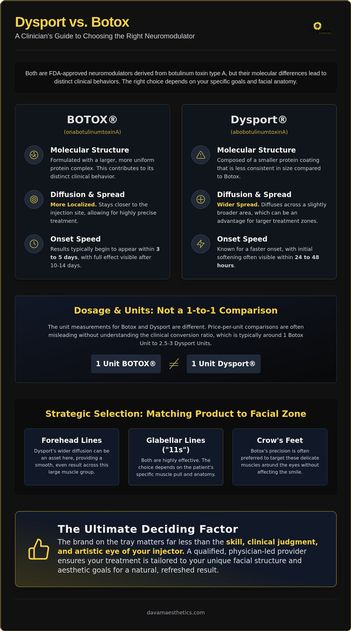
The brand of neurotoxin sitting on the tray matters far less than the hands and judgment behind the needle. That’s the truth most comparison guides won’t tell you when you’re searching for Dysport vs Botox in The Woodlands and wondering which one will finally give you that refreshed, natural look you’ve been after.
If you’ve ever hesitated to book an appointment because you’re worried about looking frozen, or you’ve stared at a price-per-unit breakdown that left you more confused than when you started, you’re not alone. These are the exact concerns that deserve a thoughtful, honest answer rather than a rushed recommendation.
This guide cuts through the noise. You’ll discover the meaningful clinical differences between Botox and Dysport, how each one behaves in different areas of the face, and what actually determines whether your results look effortlessly natural or noticeably “done.” Most importantly, you’ll understand why the right choice isn’t simply about the product itself; it’s about finding a physician-led provider in The Woodlands who takes the time to understand your face, your goals, and the expression you want to keep.
Understanding Neurotoxins: The Science of Botox and Dysport
Before you can make a confident decision about Dysport vs Botox in The Woodlands, it helps to understand what these products actually are at a molecular level. Both are derived from Clostridium botulinum, a bacterium that produces one of the most precisely studied proteins in modern medicine. When purified, refined, and administered in controlled therapeutic doses, this protein becomes a remarkably effective tool for softening the facial expressions that, over time, etch themselves permanently into the skin.
The clinical term “neuromodulator” is actually more precise than the commonly used “neurotoxin,” and it reflects how these treatments function in a cosmetic context. Rather than damaging tissue, they modulate nerve communication, temporarily interrupting the signal between a motor nerve and the muscle it controls. The result is a targeted, reversible relaxation that allows overlying skin to smooth without compromising the surrounding facial structure.
Botox carries the designation onabotulinumtoxinA, while Dysport is classified as abobotulinumtoxinA. Both received FDA approval for cosmetic use, and both have well-established safety profiles supported by decades of clinical data. Understanding the botulinum toxin neurotoxin mechanism clarifies why these two products, though related, behave differently in practice.
How Neurotoxins Work to Smooth Wrinkles
Every time you squint, frown, or raise your brows, the underlying muscle contracts and folds the skin above it. Over years, these repeated movements create dynamic wrinkles, lines that appear during expression. Left unaddressed, those same lines deepen into static wrinkles, visible even when your face is completely at rest. Neuromodulators interrupt the nerve-to-muscle signal before the contraction occurs, and consistent treatment over time actively prevents dynamic lines from graduating into permanent, etched-in creases.
Molecular Weight and Protein Coatings
This is where the two products diverge in ways that matter clinically. Botox is formulated with a more uniform, higher-molecular-weight protein complex. Dysport’s protein coating is smaller and less consistent in size. That distinction influences how each product diffuses from the injection site: Dysport tends to spread across a slightly wider area, while Botox remains more localized. Neither behavior is inherently superior. In larger treatment zones like the forehead, broader diffusion can be an asset. In precise areas like the lip line, tighter localization is often preferred. A skilled physician evaluates your specific facial anatomy to determine which molecular behavior aligns with your goals.
For patients exploring Dysport vs Botox in The Woodlands, this molecular distinction is exactly the kind of nuance that a physician-led practice like Davam Aesthetics considers during a personalized consultation, rather than defaulting to a one-size-fits-all recommendation.
Speed and Spread: How Results Differ Between Brands
Two people can walk out of the same treatment room having received the same number of units in the same facial zones, yet experience meaningfully different timelines and visual results depending solely on which product was used. When evaluating Dysport vs Botox in The Woodlands, onset speed and diffusion behavior are the two clinical variables that most directly shape the patient experience, and they’re the ones most often glossed over in generic comparison content.
The Dysport Advantage: Faster Onset
Dysport’s smaller protein complex doesn’t just influence how far it spreads; it also affects how quickly it binds to nerve receptors at the treatment site. Most patients begin noticing an initial softening within 24 to 48 hours of their appointment. Full results continue to develop over the following week, but that early visible movement sets Dysport apart for patients with time-sensitive events on the calendar.
If you have a wedding, a significant professional engagement, or a milestone celebration approaching, Dysport’s faster onset gives you a meaningful buffer. Rather than scheduling your appointment as close to the event as possible and hoping for the best, you have a wider window in which results can settle naturally before you need to look your best.
The diffusion characteristic that comes with Dysport’s molecular profile also tends to produce a softer, more blended appearance across broad treatment areas. On the forehead in particular, where muscle activity spans a wide horizontal band, this natural spread can eliminate the patchy or uneven softening that sometimes results when a product stays too tightly localized. Research on the clinical differences between botulinum toxin formulations confirms that these diffusion distinctions are measurable and clinically significant, not simply anecdotal.
The Botox Advantage: Meticulous Precision
Botox’s higher-molecular-weight complex means it stays reliably close to the injection point. That behavior is not a limitation; in the right anatomical zones, it’s exactly the property you want.
Consider two areas where precision is paramount:
- Brow shaping: A carefully placed Botox injection can create a subtle, controlled lift at the lateral brow, a delicate adjustment that requires the product to remain exactly where it’s deposited rather than migrating into adjacent musculature.
- Crow’s feet: The orbicularis oculi muscle surrounding the eye is surrounded by structures where unintended spread carries real risk. Botox’s tighter behavior reduces the likelihood of affecting the muscles responsible for eyelid elevation, making it the preferred choice for many experienced injectors in this zone.
For both products, patients should plan for 10 to 14 days before assessing their final results. Early softening is encouraging, but the full picture emerges as the neuromodulator completes its binding process and the skin above begins to relax completely. Adjusting expectations to that timeline prevents premature concern and allows for an accurate evaluation at a follow-up visit.
Understanding how each product behaves in your specific facial anatomy is precisely the kind of nuanced conversation worth having before your first injection. If you’re ready to explore which approach fits your goals, schedule a personalized consultation at Davam Aesthetics to discuss the right product and placement strategy for your face.
Dosage and Longevity: Calculating Units and Duration
Unit counts are one of the most misunderstood aspects of neurotoxin treatment, and they’re responsible for more patient confusion than almost any other topic. When comparing Dysport vs Botox The Woodlands patients frequently encounter, the numbers look dramatically different on paper, which can make Dysport seem like a more aggressive treatment or Botox seem more economical. Neither interpretation is accurate without understanding what a unit actually measures.
A unit is a measure of biological potency, not a measure of volume. It quantifies how effectively a given amount of product inhibits muscle activity, not how much liquid enters your skin. That single distinction reframes the entire dosage conversation.
The 3:1 Unit Ratio Explained
Dysport requires approximately three times as many units as Botox to achieve a comparable degree of muscle relaxation in the same treatment area. Sixty units of Dysport isn’t “more” than twenty units of Botox; it’s a different unit of measurement applied to a less concentrated formulation. Responsible providers price accordingly, so the per-treatment cost between the two products tends to be comparable when correctly dosed. A practice quoting Dysport at a lower per-unit price without adjusting the total unit volume isn’t offering a bargain; it’s potentially under-treating you. This is precisely why price-per-unit comparisons without clinical context can lead patients toward decisions that don’t serve their actual goals.
Maximizing the Life of Your Injections
Both products generally maintain their effect for three to four months, but that range isn’t fixed. Several personal factors influence how quickly your body metabolizes the neuromodulator:
- Metabolic rate: Patients with higher metabolic rates, including those who exercise intensively, tend to process neurotoxins faster. High-intensity training several times per week can noticeably shorten duration.
- Sun exposure: Chronic UV exposure degrades collagen and accelerates skin aging, which can make results appear shorter-lived even when the product itself is still active.
- Muscle mass and expression habits: Strong expressors, people whose facial muscles are particularly active or well-developed, often require higher doses and may notice earlier return of movement. Consistent treatment over time actually trains these muscles to remain more relaxed between appointments, gradually extending the interval between visits.
Supporting your results between appointments doesn’t require dramatic lifestyle changes. Diligent SPF use, adequate hydration, and a physician-recommended skincare routine all contribute to a healthier skin environment that allows results to look their best for longer. Treatments like HydraFacial or SkinPen Microneedling, both offered at Davam Aesthetics, complement neurotoxin results by improving overall skin quality between sessions.
Dosage planning for any patient involves more than arithmetic. Muscle anatomy, treatment history, lifestyle, and personal expression goals all factor into a truly personalized recommendation, which is why this conversation belongs in a physician-led consultation room rather than a comparison chart.
Strategic Selection: Matching the Injectable to Your Facial Goals
Knowing how each product behaves molecularly is only half the equation. The other half is understanding how those behaviors translate to specific areas of your face, because the forehead is not the crow’s feet, and the lip line is not the jawline. Smart product selection is inherently anatomical, and it’s the dimension of the Dysport vs Botox The Woodlands conversation that most comparison guides skip entirely.
The Best Choice for Forehead and Glabellar Lines
The forehead is a wide, continuous band of muscle activity. When a product stays tightly localized here, the result can be uneven softening: smooth in some spots, still active in others. Dysport’s natural diffusion tendency works in its favor across this broad horizontal zone, producing a more uniform relaxation that reads as genuinely refreshed rather than selectively treated. Patients who’ve struggled with a patchy or “striped” forehead after previous treatments often find that Dysport’s spread resolves exactly that concern.
The glabellar complex, the paired corrugator muscles responsible for the vertical “11” lines between the brows, is a different story. These furrows are concentrated, deeply anchored, and often more resistant in patients who’ve been expressing strongly for decades. Precise, potent placement is the priority here. Many experienced injectors prefer Botox’s tighter localization for addressing deep glabellar furrows, ensuring the product works exactly where it’s deposited without diffusing into adjacent structures that contribute to natural brow position.
Precision Work: Crow’s Feet and the Lower Face
The eye area demands a different level of restraint. The orbicularis oculi muscle wraps around the eye and sits in close proximity to the levator palpebrae, the muscle responsible for keeping your eyelid elevated. Unintended product migration in this zone isn’t merely an aesthetic inconvenience; it can temporarily affect eyelid function. Botox’s more localized behavior makes it the preferred choice for crow’s feet and for the subtle lateral brow lift that opens the eye without distorting your natural expression.
Lower face treatments introduce yet another layer of nuance. Consider the options available:
- Bunny lines: The diagonal creases that appear across the nose bridge during animated expression respond well to small, precise doses of either product, though Botox’s localization reduces the risk of affecting the levator labii muscle nearby.
- Perioral lines: Fine vertical lines above the lip require conservative, targeted placement. Dysport’s spread makes it a less common choice here; Botox allows the injector to soften lines without compromising the lip’s ability to move naturally when you speak or smile.
- Masseter reduction: For patients dealing with jaw tension or a widened lower face from enlarged masseter muscles, neurotoxin injections into this thick, powerful muscle can provide meaningful relief and facial slimming. The masseter’s size actually accommodates Dysport’s diffusion well, though the treating physician’s preference and your anatomy guide the final selection.
- The Lip Flip: A small injection into the orbicularis oris muscle just above the upper lip creates a subtle eversion that enhances lip appearance without adding volume. Precision is everything here, and most practitioners reach for Botox for this technique.
It’s also worth noting that Botox and Dysport don’t have to compete within a single session. A thoughtful injector might use Dysport across the forehead for its broad, even softening, while reserving Botox for the eye area and lower face where precision is paramount. That kind of customized, anatomy-driven approach is exactly what separates a truly personalized treatment plan from a standardized protocol.
If you’re ready to discuss which product, or combination of products, fits your specific facial goals, book a consultation at Davam Aesthetics and experience the difference a physician-led strategy makes.
The Boutique Experience: Why Your Injector in The Woodlands Matters Most
Every clinical comparison between Botox and Dysport eventually arrives at the same conclusion: the product is secondary. The physician holding the needle, the depth of their anatomical knowledge, and the quality of the conversation that precedes the treatment are what genuinely determine whether you leave looking refreshed or regretful. That truth is the foundation upon which Davam Aesthetics was built.
Davam Aesthetics operates under a physician-led model affiliated with the Davam Health medical group, which means the clinical standards governing your care are substantively different from what you’d encounter at a general med spa or a high-volume injection clinic. Physician oversight isn’t a marketing phrase here; it’s the structural reality that shapes every consultation, every dosage decision, and every follow-up conversation. When the question of Dysport vs Botox The Woodlands patients bring to their first appointment is answered by someone with that level of clinical authority, the recommendation carries genuine weight.
Concierge-Style Aesthetic Care
The experience at Davam’s boutique Magnolia office begins with a comprehensive facial analysis, not a quick glance and a predetermined protocol. Your muscle activity, skin quality, expression patterns, and long-term goals are all considered before a single product is selected. The result isn’t just a treatment plan for today; it’s a personalized rejuvenation roadmap that accounts for how your face will continue to change over time.
Patients traveling from Spring, Tomball, and surrounding communities consistently describe the atmosphere as something distinct from what they’ve encountered elsewhere. There’s no rushed energy, no sense that you’re one appointment in a long queue. The environment is calm, sophisticated, and designed to put you at ease before you’ve even sat down for your consultation. That quality of attention isn’t incidental; it’s deliberate, and it directly influences the quality of care you receive.
Your Journey to Natural Refreshment
Neurotoxin results don’t exist in isolation. The health of the skin surrounding those treated muscles plays a meaningful role in how natural and lasting your results appear. Davam’s approach recognizes this connection, which is why neurotoxin treatments are often discussed alongside skin quality interventions. Exploring skin rejuvenation in Woodlands, TX alongside your injectable strategy creates a more cohesive outcome, one where the surface reflects the same refinement as the underlying muscle work.
Choosing between Dysport and Botox doesn’t have to feel like a high-stakes decision made in isolation. With the right physician-led team, it becomes a straightforward, well-informed conversation. Schedule your consultation for Botox or Dysport at Davam Aesthetics and discover what genuinely personalized aesthetic care looks and feels like.
Your Next Step Toward a More Refreshed You
The Dysport vs Botox The Woodlands decision doesn’t have to feel overwhelming. What this guide makes clear is that both products are clinically proven, both deliver genuine results, and the meaningful difference lies in how each one behaves across specific areas of your face. Molecular diffusion, onset speed, and anatomical precision all matter, but none of those variables outweigh the judgment of the physician-led team guiding your treatment.
That’s exactly what sets Davam Aesthetics apart. From the boutique environment in Magnolia to the concierge-style consultations that serve patients across The Woodlands, Tomball, and beyond, every detail of the experience is designed around your individual goals, not a standardized protocol.
You deserve results that look like you, only refreshed. Book your personalized Botox or Dysport consultation at Davam Aesthetics and take the first step toward treatment that’s as thoughtful as it is transformative.
Frequently Asked Questions About Dysport vs Botox in The Woodlands
Is Dysport cheaper than Botox in The Woodlands?
The per-unit price of Dysport is typically lower than Botox, but that comparison is misleading without context. Because Dysport requires roughly three times as many units to achieve equivalent results, the total treatment cost between the two products tends to be comparable when correctly dosed. A practice quoting dramatically lower Dysport pricing without adjusting unit volume accordingly may be under-treating you, not offering a genuine value.
Rather than fixating on per-unit figures, ask your provider about the total units recommended for your specific treatment areas and the reasoning behind that dosage. That conversation gives you a far more accurate picture of what you’ll actually spend, and what you’ll actually receive.
How soon can I see results after my Dysport injection?
Most patients notice initial softening within 24 to 48 hours of their Dysport appointment. That early movement is one of Dysport’s most appreciated clinical characteristics, particularly for patients with time-sensitive events approaching. Full results continue to develop over the following seven to ten days as the neuromodulator completes its binding process and the overlying skin relaxes completely.
Resist the urge to evaluate your outcome before that two-week mark. Early results are encouraging, but they don’t yet reflect the finished picture. A follow-up conversation with your provider after day fourteen gives you the most accurate basis for assessing whether any refinement is warranted.
Will my face look frozen if I choose Dysport over Botox?
The frozen appearance people fear isn’t a product problem; it’s a dosing and placement problem. Both Dysport and Botox can produce natural-looking results or an overdone appearance depending entirely on how much product is used and where it’s deposited. A skilled, physician-led injector calibrates dosage to soften movement without eliminating it, preserving the expressive quality that makes your face distinctly yours.
Choosing a provider whose clinical philosophy centers on natural refreshment rather than maximum muscle suppression is the most reliable protection against that outcome. The product brand is secondary to the judgment guiding the needle.
Can I switch from Botox to Dysport if I’ve used one for years?
Yes, switching between neurotoxins is clinically straightforward and quite common. Some patients find that after years of consistent Botox use, their results begin to feel shorter-lived, which may indicate a shift in how their system responds to that particular formulation. Transitioning to Dysport, or vice versa, can restore the duration and quality of results for some individuals.
The key is communicating your full treatment history honestly during your consultation. Your provider will factor in your previous product, typical dosage, duration of results, and any areas of concern before recommending a new approach. Switching isn’t starting over; it’s refining your strategy with more information.
Are there more side effects with Dysport than with Botox?
Both products carry a comparable side effect profile. Temporary redness, minor swelling, and mild bruising at the injection site are the most common responses to either neuromodulator, and they typically resolve within a few days. Headache following treatment is occasionally reported with both products as well.
The side effects most worth discussing with your provider are the rare ones tied to product migration, such as temporary eyelid heaviness, which are more closely related to injection technique and placement precision than to the specific brand used. This is another reason why the clinical expertise of your injector matters more than which product is in the syringe.
How long do I need to wait between neurotoxin treatments?
Most providers recommend waiting a minimum of three months between full neurotoxin treatments. That interval allows the previous product to metabolize fully before re-treating, which helps maintain consistent results and avoids the cumulative over-relaxation that can occur when appointments are scheduled too closely together. Some patients with faster metabolic rates find their movement returns slightly earlier and adjust their schedule accordingly.
If you feel your results are wearing off sooner than expected, that’s a valuable data point to bring to your next consultation rather than a reason to book an earlier appointment unilaterally. Your provider can assess whether a dosage adjustment or a different product would better serve your goals going forward.
Can I exercise immediately after my Botox or Dysport appointment?
Most providers advise avoiding strenuous physical activity for at least four hours following your neurotoxin treatment, with many recommending you wait until the following day. Elevated heart rate and increased blood flow can potentially accelerate product migration away from the intended injection site before it has fully bound to the nerve receptors. Staying upright and avoiding lying flat for several hours after your appointment is also generally recommended.
Beyond the immediate post-treatment window, patients who exercise intensively on a regular basis should know that high metabolic activity over time can shorten the overall duration of their results. This is worth discussing openly during your consultation so your provider can account for it in your dosage planning.
Which is better for preventing wrinkles in your 20s or 30s?
Both products are equally valid for preventive treatment, and starting neurotoxin therapy before lines become deeply etched is one of the most effective strategies in aesthetic medicine. The goal at this stage isn’t correction; it’s interrupting the repeated muscle contractions that would otherwise graduate dynamic lines into permanent creases over time. Consistent, conservative treatment in your 20s or 30s can meaningfully delay the need for more intensive intervention later.
For patients exploring Dysport vs Botox in The Woodlands as a preventive measure, the product selection is less critical than establishing a relationship with a physician-led provider who can calibrate dosage appropriately for your age, muscle activity, and skin condition. Starting conservatively and adjusting over time is the hallmark of a thoughtful preventive approach.