- Categories :
- More
Thinking About Installing a Ceiling Fan? Here's What the Job Actually Involves
By:
 Adam Taylor The Handyman
| Published 05/29/2026
Adam Taylor The Handyman
| Published 05/29/2026


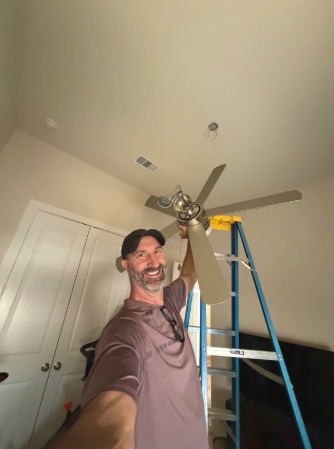
A ceiling fan looks like a simple weekend project. Sometimes it is. But the difference between a smooth two-hour job and a frustrating all-day mess usually comes down to a few things you can't see from the floor.
Here's what's really going on up there.
Are You Replacing a Fan, or Starting From Scratch?
This is the big fork in the road.
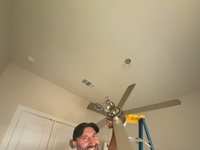
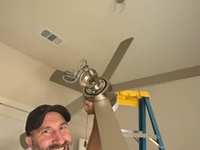
If there's already a ceiling fan where you want the new one, you're in good shape. The wiring is there, the switch works, and — most importantly — the electrical box overhead is almost certainly rated to hold a fan. That's a straightforward swap.
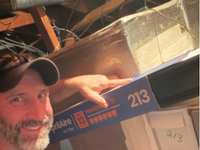
If you're putting a fan where there's only a light fixture, that's a different story. Regular light fixtures hang from a box that isn't built to handle the weight and constant motion of a spinning fan. That box has to be swapped for a fan-rated one, which often means getting up into the attic or opening the ceiling. And if there's no wiring or switch at all where you want the fan? Now you're talking about running a new circuit — and that's an electrician's job, not a handyman's.
The Part Everyone Underestimates: The Box
A fan that's mounted to the wrong box is the most common problem I see. It might hold for a while. Then one day the wobble gets worse, the screws work loose, and you've got a heavy fan hanging by its wires.
A proper fan-rated box is either braced between the ceiling joists or screwed directly into one. It's built to carry the load and absorb the vibration. If you're not sure what your fan is mounted to, that's worth checking before anything else.
Why Wobble Happens
A little wobble is almost never the ceiling falling apart. Usually it's one of these:
- Blades that aren't all sitting at the same angle
- A blade or two that got slightly bent in the box
- Loose screws where the blades meet the motor
- The fan not seated tightly against the mounting bracket
Most wobble is fixable in a few minutes once you know where to look. A fan that's properly balanced should run smooth and quiet on every speed.
When It's a Quick Job and When It Isn't
A straight replacement — same spot, working switch, fan-rated box already up there — is usually quick and painless. That's the kind of job that's done before lunch.
It gets longer when the box needs replacing, when the old fan was wired oddly by a previous owner, or when you've got a two-story foyer and the fan is fifteen feet up. High ceilings turn a simple job into a real one fast, mostly because of the ladder situation.
And when a job goes smooth, it really goes smooth. Here's a real example. A neighbor in College Park was quoted $900 to replace four ceiling fans. She called me for a second opinion, and I told her I was confident I could beat it. Once she saw how fast the work went, she ran out and bought a fifth fan — and I replaced all five in four hours for $490. Five fans, hundreds saved. That's the difference between a fan-for-fan swap done right and what some outfits charge for it.
The Honest Answer on Doing It Yourself
If you're swapping a fan for a fan and you're comfortable on a ladder and turning off the right breaker, it's a very doable project. Take your time, support the fan while you wire it, and double-check it's snug before you let go.
If you're going from a light to a fan, dealing with a box you're not sure about, or working up high — that's when it's worth bringing someone in. I handle ceiling fan replacements and upgrades all over The Woodlands, from Alden Bridge to Creekside Park, and a fair number of those calls start with "I thought this would be easier."
Worth knowing: my TDLR appliance licenses specifically cover replacing and upgrading existing ceiling fans, so this is squarely in my wheelhouse.
If you've got a fan you'd rather not wrestle with — or you're staring at a light fixture wondering if a fan can even go there — here's how I handle ceiling fan installation. Give me a call at (281) 827-2614 and I'll get it spinning right.