- Categories :
- More
DWI in a Texas School Zone Is Now a Felony: SB 826
By:
 Griffin & Cain, Attorneys at Law, PC
| Published 07/07/2026
Griffin & Cain, Attorneys at Law, PC
| Published 07/07/2026


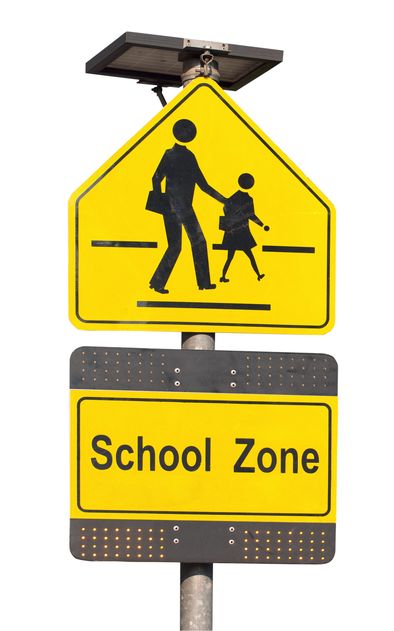
Before September 1, 2025, a first-time DWI in Texas was a Class B misdemeanor, regardless of where the driver was stopped. That changed when SB 826 took effect. Under this law, a DWI committed in a school crossing zone is now a state jail felony, punishable by 180 days to 2 years in a state jail facility and a fine of up to $10,000. This is not a repeat-offender enhancement. This applies to first-time DWI charges when the offense occurs in a school zone.
At Griffin & Cain, Attorneys at Law, our DWI defense attorneys in Conroe handle cases across Montgomery County — including the dozens of school zones surrounding Conroe ISD, Magnolia ISD, Willis ISD, and The Woodlands schools. If you or a family member has been charged with a school zone DWI, call (936) 441-2999 immediately. A felony charge demands immediate, experienced representation.
What Is a “School Crossing Zone” Under Texas Law?
A school crossing zone is the area within a roadway that is designated by official traffic signs and pavement markings as a school zone. It does not include the entire perimeter around a school campus — only the marked crossing area on the road. However, the zones can be surprisingly expansive. Many Montgomery County schools have crossing zones that extend several hundred yards in each direction along the adjacent road.
The school zone speed limit signs are the most visible marker, but the criminal enhancement applies to the crossing zone designation — not the speed limit. If you are driving through a marked school crossing zone while intoxicated, SB 826 applies whether school is in session or not. The statute references the zone itself, not the time of day or the school calendar.
This is an important distinction. A driver arrested for DWI on Loop 336 in Conroe at 10:00 p.m. on a Saturday might not realize they were in a school crossing zone — but if the arrest location falls within the marked zone for a nearby campus, SB 826 applies. The time of day and day of the week are irrelevant to the enhancement.
How SB 826 Changes the Penalty Structure
Without the school zone enhancement, a standard first-offense DWI in Texas is a Class B misdemeanor. The penalties include a fine of up to $2,000, jail time of 72 hours to 180 days, driver’s license suspension of 90 days to one year, and potential probation with DWI education and community service.
With the school zone enhancement under SB 826, the same first-offense DWI becomes a state jail felony. The penalties jump to a fine of up to $10,000, confinement of 180 days to 2 years in a state jail facility (not county jail), a permanent felony on your criminal record, and loss of the right to possess firearms under federal law.
The difference between a Class B misdemeanor and a state jail felony is not incremental — it is transformative. A misdemeanor DWI is embarrassing and expensive but manageable. A felony DWI changes your life. Employment applications ask about felony convictions. Professional licenses may be revoked or denied. Custody arrangements can be affected. Immigration status for non-citizens may be jeopardized. And the social stigma of a felony conviction follows you permanently.
School Zones in Montgomery County: Where Are They?
Montgomery County has hundreds of school campuses across Conroe ISD, Magnolia ISD, Willis ISD, New Caney ISD, Splendora ISD, and Montgomery ISD. School crossing zones are concentrated along major corridors where schools sit adjacent to high-traffic roads — Loop 336 in Conroe, FM 1488 in Magnolia, SH 75 in Willis, Research Forest Drive and Woodlands Parkway in The Woodlands, and FM 1097 near Lake Conroe.
Many drivers pass through school crossing zones multiple times per day without consciously registering them. The zones are marked by signs and pavement markings, but after driving the same route for years, they fade into background. That inattention does not protect you from SB 826. If you are stopped for DWI and the officer’s GPS coordinates place you within a designated crossing zone, the enhancement applies automatically.
Defense Strategies for School Zone DWI Cases
SB 826 is new, and the defense bar is actively developing strategies to challenge school zone enhancements. Several potential defense angles include:
Challenging the zone designation. Was the location actually within a properly designated school crossing zone? If the signage was missing, obscured, or incorrectly placed, the enhancement may not apply. Your attorney should obtain photographs of the location, review the signage ordinance, and confirm that the zone was properly established under the Transportation Code.
Challenging the stop itself. The Fourth Amendment requires that the officer have reasonable suspicion to initiate the traffic stop. If the stop was unlawful — no observed traffic violation, no articulable signs of impairment — then all evidence obtained after the stop, including BAC results, may be suppressed. Without the evidence, the case collapses regardless of the school zone enhancement.
Challenging the intoxication element. The state must still prove intoxication beyond a reasonable doubt. Breath and blood tests have known margins of error. Environmental factors (medications, fatigue, medical conditions) can mimic impairment. An experienced DWI defense attorney will challenge the reliability of the testing equipment, the qualifications of the testing personnel, and the chain of custody of blood samples.
Negotiating below the enhancement. In some cases, the most effective strategy is negotiating with the prosecutor to charge the offense as a standard DWI (Class B or Class A misdemeanor) without the school zone enhancement — particularly when the evidence of intoxication is strong but the school zone designation is borderline. Prosecutors have discretion to file charges below the maximum enhancement, and experienced defense counsel can often negotiate a reduction.
What to Do If You Are Arrested for DWI in a School Zone
Invoke your right to remain silent and your right to an attorney immediately. Do not answer questions about where you were coming from, how much you had to drink, or whether you knew you were in a school zone. Request an attorney and stop talking.
You have 15 days from the date of arrest to request an ALR hearing to contest your driver’s license suspension. This deadline does not move for weekends or holidays. Call an attorney within 24 hours of your arrest — before the weekend ends, before you “think about it,” before you do anything else.
Note the exact location of your arrest — the intersection, the mile marker, or the nearest landmark. Take photographs of the area, including any school zone signage (or lack thereof), as soon as possible after your release. This evidence may be critical to challenging the school zone enhancement.
Griffin & Cain has defended DWI cases in Montgomery County for years, and we are equipped to handle the new SB 826 school zone enhancement. Call (936) 441-2999 for a free, confidential consultation. We serve clients in Conroe, The Woodlands, Magnolia, Willis, Huntsville, and every court in the region.