- Categories :
- More
Higher Mortgage Rates Could Help Housing Inventory Grow in 2026
By:
 The McClung Group
| Published 08/24/2026
The McClung Group
| Published 08/24/2026



Could higher mortgage rates actually lead to more homes for sale in 2026?
Surprisingly, they could. While higher rates create affordability challenges for buyers, they may also help housing inventory grow, giving you more homes to choose from, more opportunities to negotiate, and potentially less pressure during your home search.
If you’re watching housing inventory in 2026 and wondering what it means for homes for sale in The Woodlands, there’s more to the story than the recent slowdown in inventory growth.
Housing Inventory Growth Has Slowed, but It Hasn’t Stopped
The number of homes available for sale is still growing nationally, just at a much slower pace than it was a year ago.
According to the Realtor.com data provided, active listings were up 2.1% year-over-year in July 2026. That’s considerably less than the 10% annual increase recorded in January and the 31.5% increase seen in May 2025.
Here’s how year-over-year active listing growth changed:
- May 2025: 31.5%
- June 2025: 28.9%
- July 2025: 24.8%
- August 2025: 20.9%
- September 2025: 17.0%
- October 2025: 15.3%
- November 2025: 12.6%
- December 2025: 12.1%
- January 2026: 10.0%
- February 2026: 7.9%
- March 2026: 8.1%
- April 2026: 4.5%
- May 2026: 2.2%
- June 2026: 1.9%
- July 2026: 2.1%
The important detail is that inventory isn't declining year-over-year. It’s still growing.
And something interesting has happened over the past three months. Instead of continuing to fall sharply, inventory growth has remained in roughly the same range: 2.2% in May, 1.9% in June, and 2.1% in July.
That relative stability could indicate that the slowdown in inventory growth is approaching a floor.
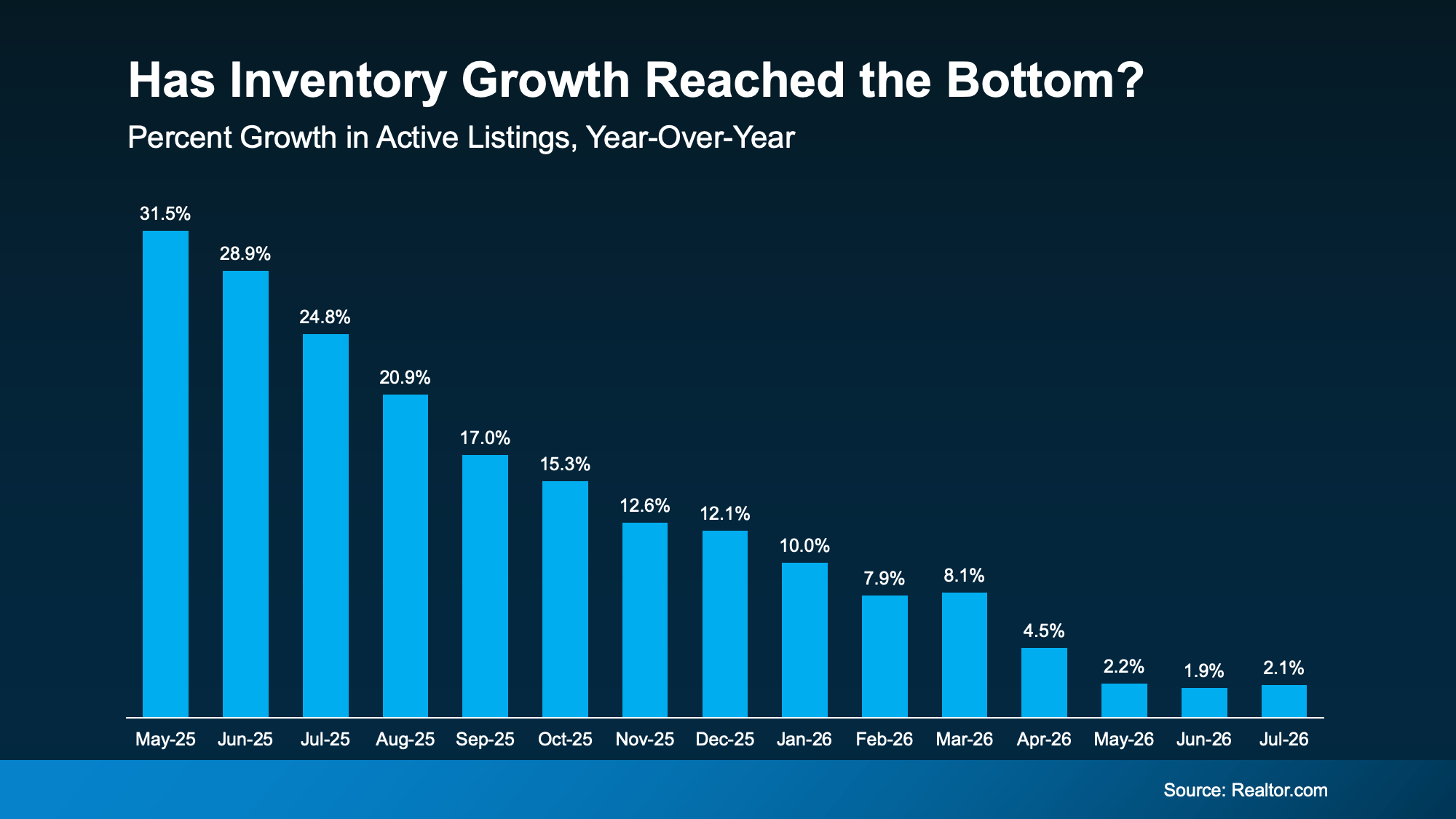
Alt text: Bar chart showing year-over-year growth in active home listings declining from 31.5% in May 2025 to 2.1% in July 2026, based on Realtor.com data.
Why Slower Inventory Growth Isn't Necessarily Bad News for Buyers
If you're planning to buy, seeing inventory growth fall from more than 30% to roughly 2% may initially sound concerning.
But the growth rate doesn't tell you how many homes are actually available.
Think of it this way: inventory can continue increasing even when the rate of that increase slows.
And that's exactly why the bigger inventory picture matters.
National housing inventory has now increased year-over-year for 33 consecutive months, according to the Realtor.com information provided. Compared with the exceptionally low inventory levels experienced several years ago, buyers have significantly more choices today.
That changes the buying environment.
When more properties are available, you may have a better opportunity to compare homes instead of feeling like you have to jump on the first acceptable property you find. Depending on the specific property and current local conditions, additional inventory may also create more opportunities for negotiation.
For buyers searching for homes for sale in The Woodlands, however, national trends should always be considered alongside what's happening locally.
Inventory can vary substantially from one neighborhood, price point, and property type to another.
Housing Inventory Is the Best It's Been Since 2019
One of the most important pieces of the current housing inventory story is how far supply has recovered.
Realtor.com data provided for this article shows 1,126,252 active listings nationally in July 2026.
Compare that with July inventory during recent years:
- 2019: 1,239,557
- 2020: 822,849
- 2021: 546,697
- 2022: 691,663
- 2023: 647,145
- 2024: 883,905
- 2025: 1,102,787
- 2026: 1,126,252
July 2026 had the highest July inventory level since 2019.
That's a significant change from the housing market buyers experienced only a few years ago.
In July 2021, there were just 546,697 active listings nationally. By July 2026, that number had more than doubled.
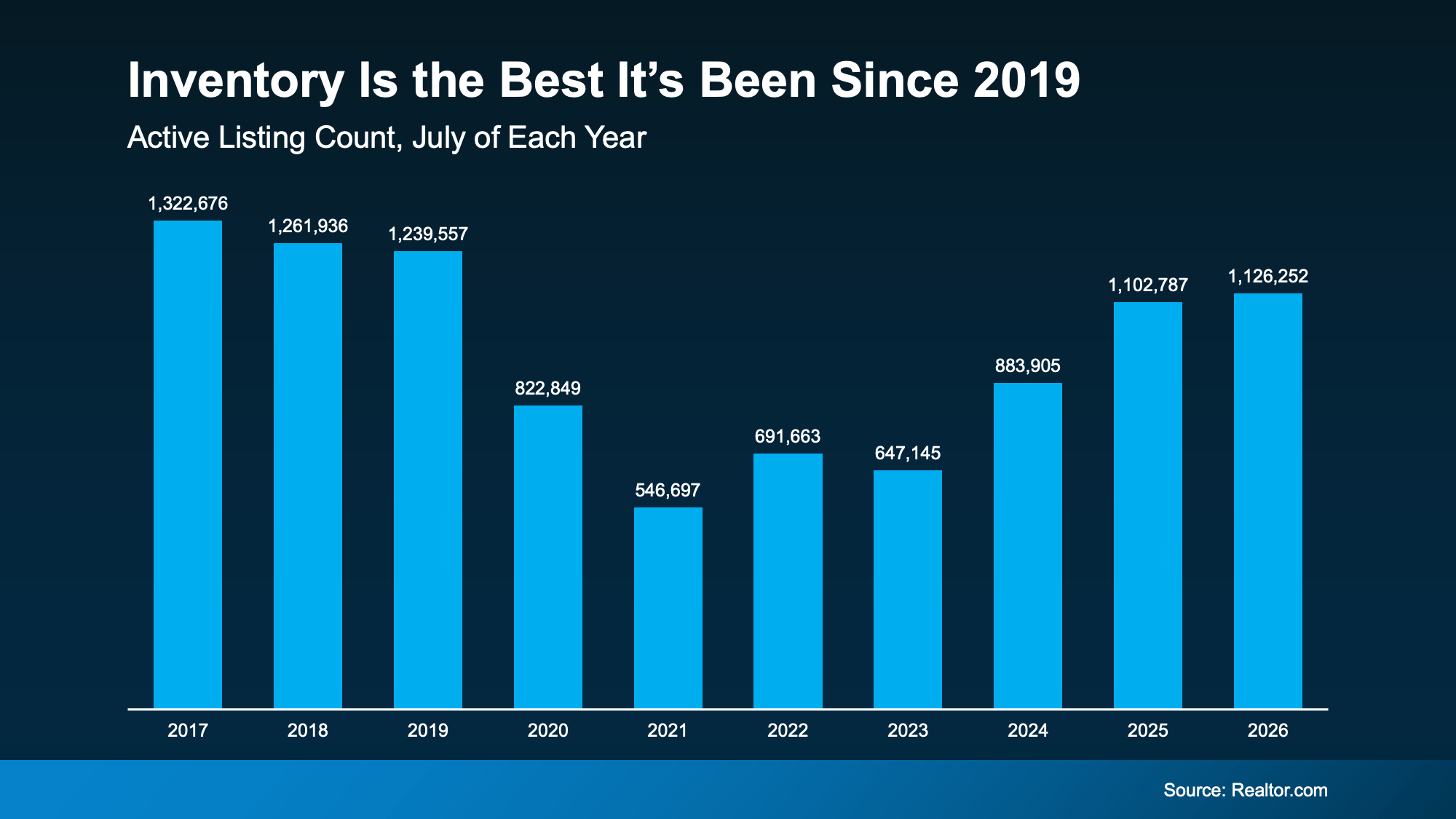
Alt text: Bar chart comparing July active home listing counts from 2017 through 2026, showing 1,126,252 active listings in July 2026, the highest July level since 2019, according to Realtor.com.
The Housing Market Is Getting Closer to Pre-Pandemic Inventory
Today's inventory still hasn't completely returned to pre-pandemic levels.
Based on the figures provided, July 2019 had 1,239,557 active listings compared with 1,126,252 in July 2026. That's a difference of roughly 113,000 listings for the July comparison.
The source material also notes that the broader market still needs approximately 150,000 additional listings to fully return to pre-pandemic levels.
But the direction is important.
Inventory has recovered substantially from its earlier lows, and Realtor.com's forecast cited in the source material projects inventory will finish 2026 3.6% higher year-over-year.
If you're buying, that means today's market may offer considerably more choice than you remember from the highly competitive conditions of a few years ago.
How Could Higher Mortgage Rates Help Housing Inventory?
This is where the housing market gets a little counterintuitive.
Most buyers naturally view higher mortgage rates as a negative. Higher rates can increase the monthly payment associated with financing a home, potentially affecting purchasing power.
But mortgage rates can also influence the supply side of the market.
As Mike Simonsen, Chief Economist at Compass, explains in the source material, inventory has recently shown a relationship with mortgage-rate movement: when rates rise, inventory tends to rise, and when rates fall, inventory tends to fall.
Why could that happen?
Higher mortgage rates can cool buyer demand. Homes may take longer to sell, and listings can accumulate rather than being purchased as quickly as they come onto the market.
That can increase the total number of homes available at any given time.
So, although buyers may prefer lower mortgage rates, elevated rates can contribute to a market where you have more properties to consider.
What Higher Inventory Could Mean for Buyers
More inventory can change your home search in several practical ways.
You May Have More Choices
The obvious benefit is selection.
When more homes are available, you're less likely to feel as though you have to choose between only a handful of properties.
That can give you more opportunity to focus on the factors that matter most to your move, such as location, layout, condition, price, and features.
You May Have More Time To Evaluate a Home
A market with more available inventory can also reduce some of the urgency buyers experienced when inventory was exceptionally limited.
That doesn't mean every property will sit on the market. Well-positioned homes can still attract strong interest.
But broader inventory can give buyers more alternatives if one particular property doesn't work out.
There May Be More Room for Negotiation
Additional inventory can also influence negotiating leverage.
When sellers are competing with more listings, pricing and presentation become increasingly important. Depending on the property and local market conditions, buyers may have opportunities to negotiate aspects of an offer.
That doesn't mean every seller will negotiate, or that every home should receive an offer below asking price.
The strategy should depend on the individual property.
That's one reason understanding the The Woodlands real estate market at a neighborhood and price-point level is so important.
What Does This Mean for Sellers?
Increasing inventory isn't only a buyer story.
If you're considering selling, more competition means your strategy matters.
When buyers have more choices, they can compare your home with other available properties. Pricing too aggressively or overlooking presentation can make it easier for buyers to move on to another listing.
That makes several factors increasingly important:
- Pricing based on current competing inventory
- Strong property presentation
- Professional marketing
- Understanding how similar homes are performing
- Responding strategically to buyer feedback and market activity
A growing inventory environment doesn't mean homes can't sell successfully. It means sellers need to understand exactly where their property fits within the current market.
What This Means for The Woodlands Real Estate Market
National housing trends provide useful context, but real estate is ultimately local.
The number of homes for sale in The Woodlands can behave differently from national inventory depending on neighborhood, property type, price range, and buyer demand.
That's why a national headline shouldn't be the only factor influencing your decision to buy or sell.
At The McClung Group, we're Realtors serving The Woodlands, and we help you look beyond broad housing-market headlines to understand what the available inventory actually means for your specific move.
For a buyer, that could mean identifying where more choices or negotiating opportunities are developing.
For a seller, it means understanding the competition you're facing and positioning your home accordingly.
Final Takeaway
Housing inventory in 2026 is still growing, even though that growth has slowed substantially. July had the highest national active listing count for that month since 2019, and the recent stabilization in year-over-year inventory growth could indicate the slowdown is approaching its bottom.
And while elevated mortgage rates aren't necessarily what buyers want to see, those same rates could help inventory continue building.
For you, the bigger question isn't simply whether national inventory is rising or falling. It's what's available in the part of the market where you want to buy or sell.
Ready To See What's Available in The Woodlands?
If you're thinking about buying, you don't have to guess what these inventory changes mean for your home search.
Contact The McClung Group to see what's currently available in The Woodlands and talk through a buying strategy based on today's market.
And if you're considering selling, we can help you understand your current competition and how your property could be positioned in a market where buyers have more options.