- Categories :
- More
What Higher Mortgage Rates Mean for Home Sellers
By:
 The McClung Group
| Published 10/01/2026
The McClung Group
| Published 10/01/2026


What do higher mortgage rates mean if you’re trying to sell your home?
Higher mortgage rates can make buyers more focused on affordability and monthly payments. As some homebuilders respond with lower rates and other incentives, sellers need to understand the competition and position their homes around what buyers can afford today.
Higher Mortgage Rates Affect Sellers, Too
When mortgage rates rise, most of the attention naturally goes to homebuyers. After all, even a relatively small change in a mortgage rate can make a noticeable difference in a buyer’s monthly payment.
But higher mortgage rates matter to sellers, too.
Today’s buyers are paying close attention to affordability. They’re looking not only at a home’s asking price, but also at what owning that home could mean for their monthly budget.
That shift can influence how buyers compare homes, negotiate offers, and ultimately decide which property gives them the best overall opportunity.
For sellers, that means understanding what buyers are seeing elsewhere in the market is increasingly important. And one source of competition deserves particular attention: new construction.
Builders Are Competing for Buyers Through Incentives
New-home sales have been holding up better than existing-home sales in the current higher-rate environment.
According to comments from Logan Mohtashami, Chief Economist at HousingWire, new-home sales recently reached an 8-month high and are running around 2019 levels. Meanwhile, existing-home sales are about 1 million sales below 2019 levels.
One reason builders have responded differently is their use of buyer incentives.
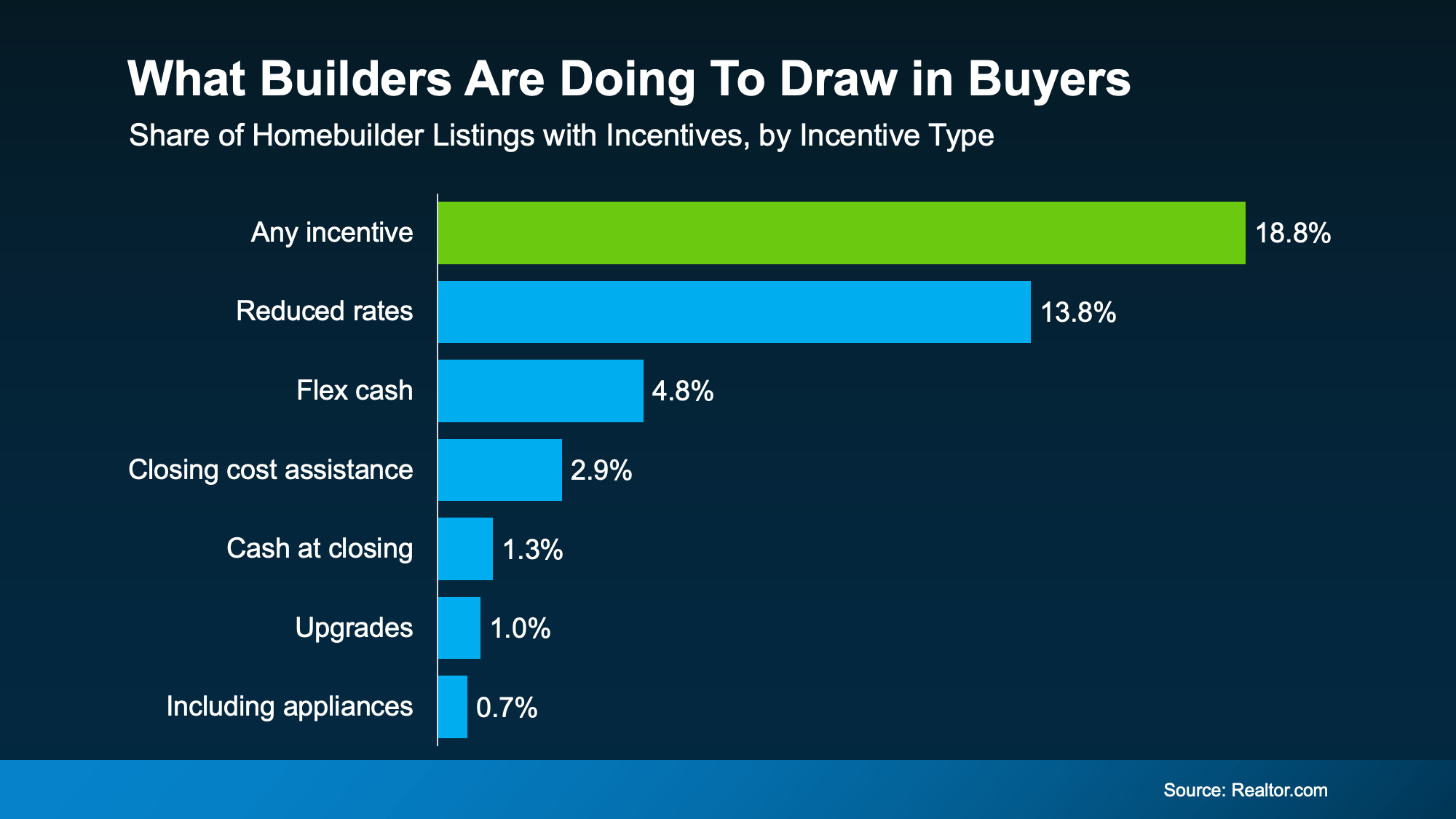
According to Realtor.com, 18.8% of newly built homes have some type of buyer incentive advertised upfront.
The incentives break down as follows:
- Reduced rates: 13.8%
- Flex cash: 4.8%
- Closing-cost assistance: 2.9%
- Cash at closing: 1.3%
- Upgrades: 1.0%
- Including appliances: 0.7%
What Builders Are Doing To Draw in Buyers
Source: Realtor.com
The biggest takeaway is that reduced mortgage rates are the most commonly advertised incentive.
That matters because builders aren’t necessarily competing on price alone. In many cases, they’re competing on the monthly payment.
Why Mortgage Rate Buydowns Matter
A mortgage rate buydown generally involves paying upfront costs to help a buyer secure a lower mortgage rate, which can reduce the buyer’s monthly payment.
For a buyer trying to manage affordability, that can make a big difference.
Some builders are offering rates below 6%, and in certain cases, considerably below 6%. Depending on the situation, that can reduce a buyer’s monthly payment by hundreds of dollars.
That changes the comparison for someone deciding between a newly built home and an existing home.
Instead of simply asking, “Which home costs less?” buyers may also be thinking:
“Which option gives me the monthly payment that works better for my budget?”
That’s an important distinction for anyone preparing to sell a home.
Can Existing-Home Sellers Offer a Rate Buydown?
Builders aren’t the only ones who can help with a buyer’s mortgage rate.
A seller can potentially contribute toward a buyer’s rate buydown, depending on the loan and the specifics of the transaction.
That doesn’t mean every seller should automatically offer one. It also doesn’t mean a rate buydown is necessary to compete for your home.
It’s simply one option that may be available.
Depending on your property, market, and prospective buyer, another approach could make more sense. That could include negotiating price, contributing toward closing costs, addressing repairs, or emphasizing the characteristics of your home and neighborhood that set it apart from competing properties.
The key is understanding your options rather than assuming price is the only tool you have.
Your Home Doesn't Have To Compete With New Construction on Everything
If you’re selling an existing home, trying to duplicate every incentive offered by a builder may not be the right strategy.
Your home may offer advantages that are different from what a new development provides.
Joel Berner, Senior Economist at Realtor.com, points specifically to location and neighborhood amenities when discussing how existing-home sellers can differentiate their properties from new construction.
That’s where thoughtful real estate marketing becomes especially important.
Instead of simply listing the number of bedrooms, bathrooms, and square feet, your marketing should communicate what makes the property distinctive.
That might mean highlighting relevant neighborhood amenities, established features, updates, outdoor spaces, lot characteristics, or other aspects of the property that matter to buyers.
The goal isn’t to make your home look like new construction. It’s to make sure buyers understand why your home deserves consideration alongside it.
Price Still Has To Reflect Today's Buyer
Builder incentives are only part of the equation.
Builders have also been adjusting prices based on current buyer demand and affordability.
Robert Dietz, Chief Economist at the National Association of Home Builders (NAHB), explains that existing homeowners now have to go through the same type of “price discovery” builders have been doing since 2022.
For sellers, that’s an important point.
The price a home could command a few years ago doesn’t automatically determine what a buyer will pay today.
Higher mortgage rates change the affordability calculation. As a result, pricing should account for what today’s buyers are experiencing—not simply what homes sold for under different market conditions.
That doesn’t automatically mean you need a dramatic price reduction or a large concession.
It means your pricing strategy should be grounded in the market buyers are actually navigating now.
Sellers Have More Than One Lever To Pull
When buyers become more cost-conscious, sellers may have several ways to make a property more compelling.
Depending on the transaction, those options could include:
- Pricing strategically. Your asking price should reflect current competition and buyer affordability.
- Considering concessions. Closing-cost assistance or other negotiated concessions may help address a buyer’s immediate financial concerns.
- Exploring a mortgage rate buydown. Depending on the buyer’s financing and transaction structure, a seller contribution toward a rate buydown may be an option.
- Addressing repairs. Resolving certain concerns before or during negotiations may make the home more appealing.
- Strengthening the home's marketing. Clearly showing what differentiates your property can help buyers understand its value compared with both resale homes and new construction.
The right approach depends on the home, the buyer, the financing, and the local competition.
New Construction Competition Varies by Market
Another important point is that new construction doesn’t have the same influence everywhere.
Some markets have a significant number of newly built homes competing for buyers. In other areas, new construction represents a much smaller portion of available inventory.
Builder incentives can also vary substantially from one community to another.
That’s why sellers shouldn’t automatically copy what they hear builders are doing nationally.
If you’re selling in The Woodlands or the surrounding area, the more useful question is what buyers are actually comparing your home against locally.
Which homes are competing with yours?
Are buyers considering new construction as an alternative?
What incentives are being offered on those homes?
How does your pricing compare?
And what does your home offer that competing properties don’t?
Those answers can help shape a more informed selling strategy.
Higher Mortgage Rates Make Positioning More Important
Higher mortgage rates don’t mean existing homes can’t compete with new construction.
They do mean sellers need to recognize that buyers are looking closely at the financial side of their decision.
Builders understand that. The prevalence of reduced-rate incentives shows how heavily some builders are focusing on the monthly payment as a way to attract buyers.
Existing-home sellers may need to think just as strategically.
That could mean adjusting price, considering a concession, exploring a rate buydown where appropriate, or making sure the home’s marketing clearly communicates advantages buyers might not get from a new build.
There isn’t one solution that applies to every seller.
The strategy should reflect the property, the competition, and what buyers in that particular market are responding to.
Final Takeaway
Higher mortgage rates can affect how you sell your home just as much as they affect how buyers shop for one.
With 18.8% of newly built homes advertising some type of buyer incentive and reduced rates appearing on 13.8% of new-home listings, sellers need to understand what they’re competing against.
That doesn’t mean automatically lowering your price or matching every builder incentive. It means knowing what buyers can afford today and positioning your home accordingly.
For homeowners in The Woodlands and surrounding areas, The McClung Group can help you evaluate your current competition—including existing homes and new construction—and determine how to position your property in today’s market.
Thinking About Selling Your Home?
If you’re considering selling, your strategy should start with understanding what today’s buyers are seeing when they compare your home with other available options.
The McClung Group, REALTORS® serving The Woodlands and surrounding areas, can help you evaluate the competition, pricing, and potential selling strategies so you can make an informed decision about your next move.
Contact The McClung Group to discuss what buyers are seeing in your market and how your home can be positioned to compete.