- Categories :
- More
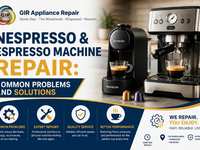
Nespresso & Espresso Machine Repair: Common Problems and Solutions
By:
 GIR Appliance
| Published 08/07/2026
GIR Appliance
| Published 08/07/2026


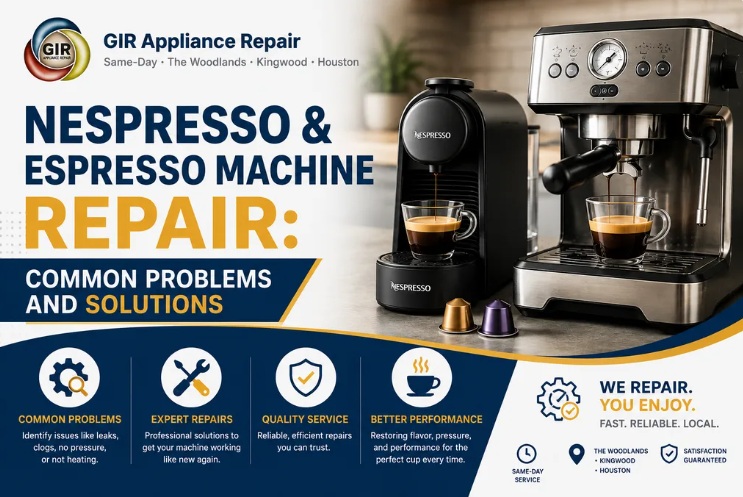
A Nespresso or espresso machine that won’t brew, leaks, or throws an error light is a small appliance with an outsized impact on your morning — for a lot of Houston-area coffee drinkers, it’s the first thing that has to work every day. GIR Appliance Repair services Nespresso, Breville, DeLonghi, Jura, Gaggia, Saeco, and Rancilio espresso machines across Houston, The Woodlands, Kingwood, Spring, and Conroe, and this guide covers the most common problems, what typically causes them, realistic repair costs, and the maintenance habits that prevent most espresso machine service calls in the first place.
Common Espresso Machine Problems & Repair Costs
| Symptom | Likely Cause | Est. Repair Cost |
|---|---|---|
| Won’t turn on | Power supply failure or blown internal fuse | $80–$220 |
| No water flow / won’t brew | Failed water pump or clogged internal lines from scale buildup | $100–$280 |
| Leaking water | Worn seals, gaskets, or a cracked internal reservoir | $90–$240 |
| Weak or inconsistent pressure | Scale buildup restricting internal lines | $80–$200 |
| Error light / descale light won’t clear | Sensor fault or incomplete descaling cycle | $90–$230 |
Scale Buildup: The #1 Cause of Espresso Machine Problems
Mineral scale from hard water is, by a wide margin, the leading cause of espresso and Nespresso machine failures. As water passes through the internal heating element and lines, minerals gradually deposit inside, narrowing passages and coating the heating element itself. Over months, this shows up as weaker pressure, longer brew times, inconsistent shot quality, and eventually a machine that won’t produce water flow at all. Houston-area water hardness varies by neighborhood, and unfiltered tap water use accelerates scale buildup significantly compared to filtered or bottled water. Most manufacturers recommend descaling every one to three months depending on usage and water hardness — a step many owners skip until the machine is already struggling.
Won’t Turn On or Power Issues
A Nespresso or espresso machine with no power response at all is usually either a failed internal fuse (a safety component designed to blow before more expensive parts are damaged by a power surge) or, less commonly, a failed power supply board on machines with more complex electronics. Before assuming an internal fault, it’s worth testing the outlet with another device and checking whether the machine has a reset button or requires holding the power button for an extended press, since some models have this quirk built in.
Leaking Water
Leaks typically come from one of two places: worn rubber seals and gaskets around the water reservoir or brew head, which naturally degrade with heat cycling over years of use, or in rarer cases, a cracked internal water line or reservoir from age or a manufacturing defect. Capsule-based machines like Nespresso have additional seal points around the capsule chamber that can wear out from repeated use and are a common leak source specific to that machine style.
Error Lights and Descale Warnings That Won’t Clear
Most modern espresso machines track usage internally and trigger a descale reminder light after a set number of brew cycles. If this light won’t clear even after running a descaling cycle, it typically means the descale program wasn’t completed correctly (often because it was interrupted partway through) or, less commonly, a sensor that monitors water flow or temperature has failed and isn’t confirming the cycle completed. A technician can usually reset the counter manually and, if needed, verify the underlying sensor is functioning correctly.
Weak or Inconsistent Shot Pressure
For traditional (non-capsule) espresso machines, weak or inconsistent shot pressure is almost always tied back to scale buildup restricting the internal water pathways, though grind consistency and tamping technique can also contribute and are worth ruling out first since they’re free to check. If shots have gradually gotten weaker over weeks or months rather than changing suddenly, scale buildup is the most likely mechanical cause. A sudden pressure drop, on the other hand, more often points to a failing pump or a partially clogged group head that needs professional cleaning beyond a standard descale cycle.
Built-In and Plumbed Espresso Systems
Higher-end kitchens in The Woodlands and greater Houston increasingly feature built-in, plumbed espresso systems integrated directly into cabinetry with a direct water line connection rather than a manual reservoir. These systems add a few additional failure points compared to countertop machines — the water line connection itself, an inline filter that needs periodic replacement, and sometimes a booster pump for water pressure. GIR technicians are experienced with both countertop and built-in plumbed systems, and diagnosing a plumbed unit typically starts with confirming whether the issue is with the machine itself or the water supply line feeding it.
DIY Maintenance That Prevents Most Repairs
- Descale every 1–3 months using the manufacturer’s recommended solution — this single habit prevents the majority of espresso machine service calls.
- Use filtered water when possible, especially in areas with harder tap water.
- Clean the brew head, portafilter, or capsule chamber after each use to prevent coffee oil buildup.
- Empty and rinse the drip tray and water reservoir regularly to prevent mineral crusting and mold growth.
- Follow the manufacturer’s full descale cycle rather than stopping early, which is a common cause of persistent descale warning lights.
Internal pump replacement, heating element repair, and circuit board diagnostics should go to a technician experienced with espresso machine internals — these machines pack a lot of components into a small housing, and reassembly errors are easy to make without the right experience.
Why Choose GIR for Espresso Machine Repair
GIR Appliance Repair technicians service Nespresso, Breville, DeLonghi, Jura, Gaggia, Saeco, and Rancilio machines, understanding the specific quirks and common failure points of each brand rather than treating every espresso machine the same. We provide upfront quotes before any repair and back completed work with a workmanship warranty. With 207+ Google reviews and a 4.9-star rating, GIR is a trusted choice for small appliance repair across Houston, The Woodlands, Kingwood, Spring, and Conroe.
Is It Worth Repairing an Espresso Machine?
For mid-range and premium machines — generally anything originally priced above $200–$300 — repair is almost always the better financial choice, since most espresso machine repairs fall well under half the cost of a comparable replacement. Built-in and plumbed espresso systems in custom kitchens are an even easier case for repair, given the added cost and disruption of replacing an integrated unit. For lower-cost entry machines under $100, a repair quote approaching the original purchase price is the point where GIR technicians will typically recommend replacement instead, and we’ll always tell you honestly which side of that line your machine falls on.
Frequently Asked Questions
How much does espresso machine repair cost?
Most repairs range from $80 to $280 depending on the failed component and brand. Pump and heating element repairs are on the higher end; seals, gaskets, and sensor issues are typically lower. GIR always diagnoses first and gives you an upfront quote before any repair begins, so there are no surprises on the final bill.