- Categories :
- More
Low Mortgage Rates or More Negotiating Power? Why Homebuyers Rarely Get Both
By:
 The McClung Group
| Published 11/09/2026



Low Mortgage Rates or More Negotiating Power? Why Homebuyers Rarely Get Both
Is it better to wait for lower mortgage rates or buy a home now while buyers have more negotiating power?
Lower mortgage rates can make monthly payments more affordable, but they often bring increased competition among buyers. In today's housing market, higher rates are creating opportunities to negotiate on home prices, closing costs, and seller concessions. If you're considering buying a home in The Woodlands, understanding this trade-off could help you make a more informed decision.
Why Low Mortgage Rates and Buyer Negotiating Power Rarely Happen Together
If you've been following mortgage rates in 2026, you know how frustrating the housing market can feel. Rates have climbed above 7%, leaving many potential homebuyers wondering whether they should move forward or wait for better conditions.
But there's something important that mortgage rate headlines don't always explain.
The lowest mortgage rate doesn't necessarily mean you're getting the best overall deal on a home.
Think back to 2020 and 2021, when mortgage rates hovered near historic lows. Buyers were eager to take advantage of affordable financing, and demand for homes increased significantly.
The problem? There weren't enough available properties to accommodate everyone looking to buy.
That imbalance created intense competition. Multiple-offer situations became common, some homes sold above their asking prices, and buyers sometimes made significant concessions to compete.
In many cases, sellers had considerably more control over negotiations.
According to Jake Krimmel, Senior Economist at Realtor.com:
"Seller's markets peaked at 98 of 100 metros in spring 2022 after two years of mortgage rates near 3%."
As mortgage rates increased throughout 2022, buyer demand began to cool. Over time, available inventory increased in many markets, giving buyers more opportunities to compare properties and negotiate.
Today, that shift is becoming increasingly apparent.
Buyers Have Gained Significant Negotiating Power in 2026
Recent research from Realtor.com highlights just how dramatically the housing market has changed.
In September 2022, 98 of the nation's top 100 metropolitan markets leaned toward sellers, while only two favored buyers.
By September 2026, the picture looked very different.
Of the top 100 metropolitan markets, 66 were classified as buyer-leaning, while 33 were seller-leaning.
This represents a substantial change in the balance between buyers and sellers.
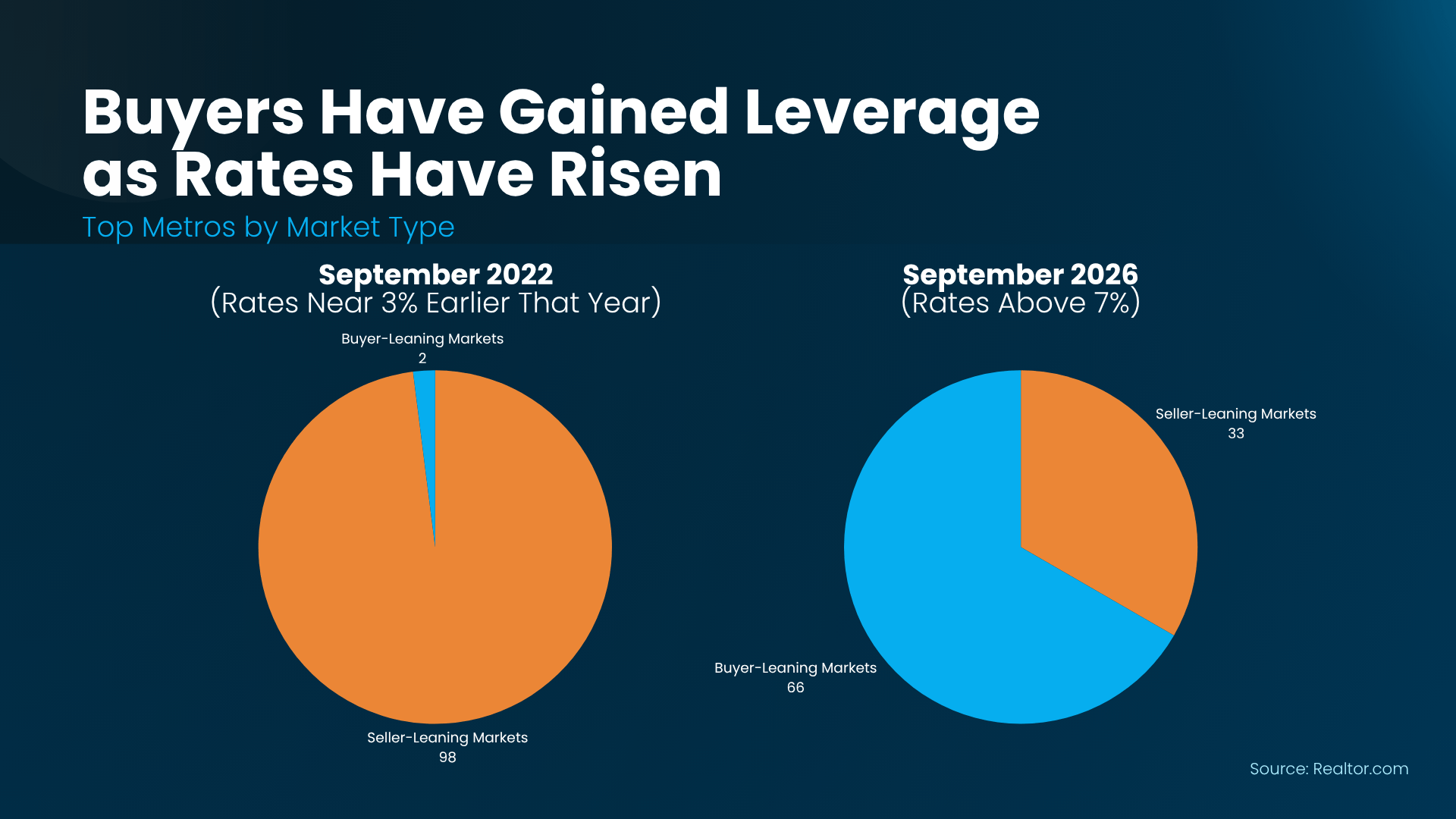
Source: Realtor.com, Market Clock Report, Q3 2026.
For buyers, this shift matters because it can create opportunities that were difficult to find during the highly competitive housing market of recent years.
When sellers face less competition from other listings and buyers have more properties to consider, negotiations may become more flexible.
Instead of feeling pressured to make an immediate offer, you may have additional time to evaluate a property's condition, compare pricing, and determine whether it fits your financial goals.
However, it's important to remember that national housing trends don't apply equally to every neighborhood.
In The Woodlands, market conditions can vary depending on the community, price range, property condition, and available inventory.
A well-priced home in a desirable location may still attract considerable interest, while another property could offer more room for negotiation.
That's why understanding the local market is just as important as following national mortgage rate trends.
What Does Buyer Negotiating Power Actually Look Like?
Having more negotiating power doesn't automatically mean every seller will accept a lower offer.
Instead, it means buyers may have more opportunities to negotiate the overall terms of a purchase.
Lawrence Yun, Chief Economist at the National Association of Realtors, explains:
"Higher inventory and lengthening days on market give buyers improved negotiating power."
For buyers considering homes in The Woodlands and surrounding communities, that negotiating power could take several forms.
1. Negotiating a Lower Purchase Price
When a home has been on the market longer than comparable properties, a seller may be more willing to consider an offer below the asking price.
However, the right offer depends on several factors, including recent comparable sales, the property's condition, and the seller's circumstances.
A strategic offer should be supported by market data rather than simply assuming every listing is overpriced.
2. Requesting Seller Contributions Toward Closing Costs
Closing costs can represent a meaningful expense when purchasing a home.
Depending on the transaction and financing requirements, a seller may agree to contribute toward eligible closing expenses.
This could help reduce the amount of cash you need at closing, making the purchase more manageable.
Seller contributions are subject to loan-program limits and must be properly negotiated and documented.
3. Exploring a Seller-Paid Mortgage Rate Buydown
A mortgage rate buydown is another option worth understanding.
In certain transactions, sellers may agree to contribute funds toward reducing a buyer's mortgage interest rate, either temporarily or permanently, depending on the financing arrangement.
A lower interest rate can reduce monthly principal and interest payments.
However, the actual benefit depends on the cost of the buydown, loan terms, eligibility, and how long you expect to keep the mortgage.
It's important to compare the financial impact of a rate buydown with other potential concessions before deciding which option offers the greatest value.
4. Negotiating Repairs or Other Contract Terms
Depending on the property and the terms of the contract, buyers may also be able to negotiate repairs, repair credits, or other conditions.
These discussions should be based on the property's condition, inspection findings, contract provisions, and the seller's willingness to negotiate.
The goal isn't simply to ask for as many concessions as possible.
It's to structure an offer that protects your interests while remaining competitive enough to achieve your homeownership goals.
Nearly Half of Homebuyers Are Receiving Seller Concessions
One of the clearest signs of changing buyer leverage comes from recent Redfin data.
In August 2026, 44.7% of home sales included a seller concession, compared with 42.6% in August 2025.
That figure has increased significantly compared with the more competitive housing market of 2021.
Here's how the share of home sales involving seller concessions has changed:
| Year | Share of Sales With Seller Concessions |
|---|---|
| 2020 | 40.1% |
| 2021 | 24.1% |
| 2022 | 27.6% |
| 2023 | 34.8% |
| 2024 | 35.3% |
| 2025 | 42.6% |
| 2026 | 44.7% |
Figures represent August home sales for each year.
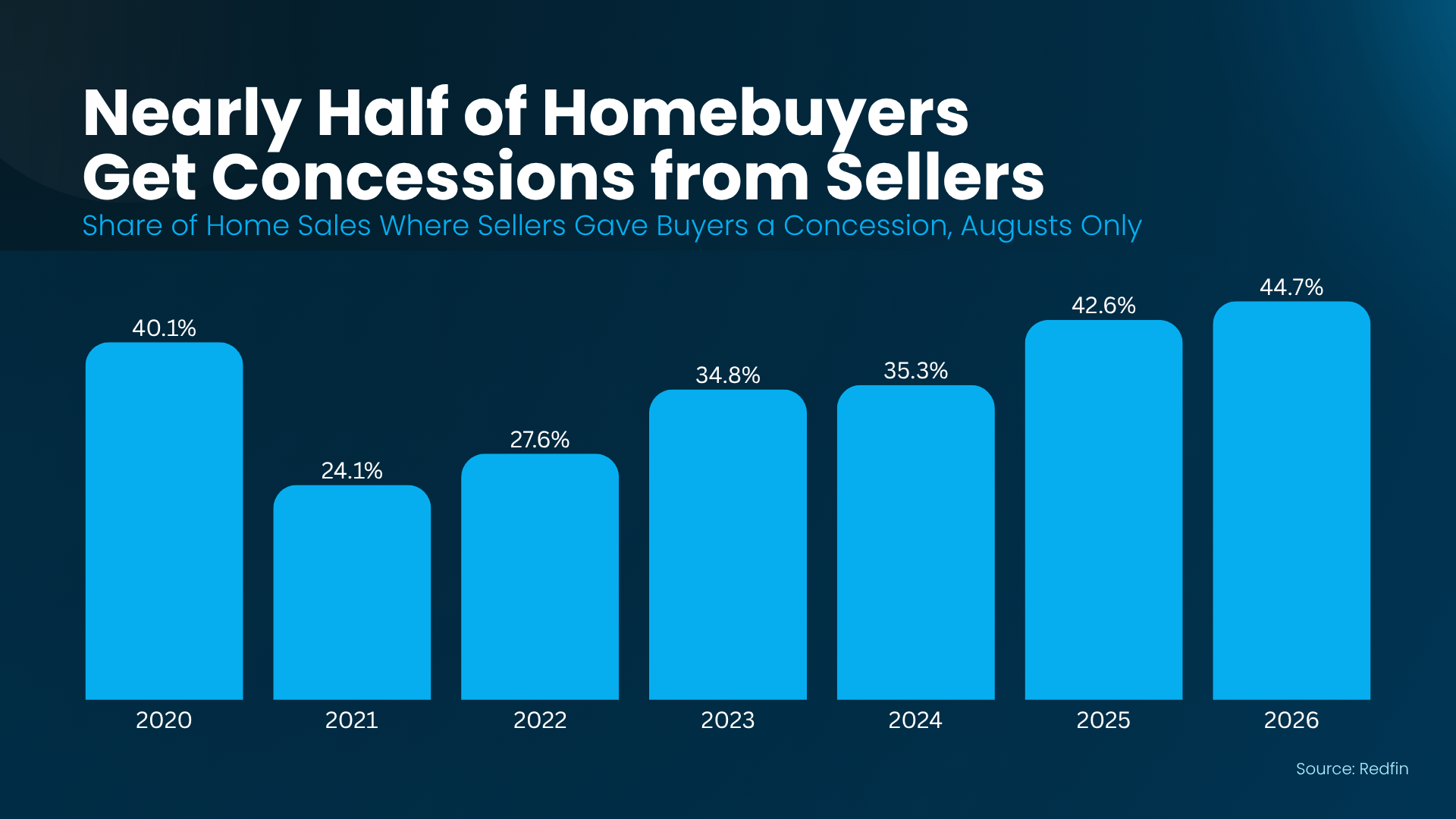
Source: Redfin.
This trend suggests that sellers are increasingly willing to negotiate terms that may help buyers complete a purchase.
For example, imagine finding a home that fits your needs but has a monthly payment slightly above your preferred budget.
Instead of immediately eliminating the property from consideration, you could explore whether the seller might consider a price adjustment or contribute toward eligible closing expenses.
Another possibility may be negotiating a seller-funded mortgage rate buydown, if your financing allows it.
Not every seller will agree, and concessions aren't guaranteed. But having the opportunity to discuss these terms gives buyers more flexibility than they may have experienced in previous years.
For anyone searching for homes in The Woodlands, Spring, Conroe, Magnolia, or nearby communities, understanding which properties may offer negotiating opportunities can make the home search more strategic.
Will Mortgage Rates Drop in 2027?
One of the biggest questions facing potential homebuyers is whether waiting until 2027 will result in significantly lower mortgage rates.
While no one can predict interest rates with certainty, the forecasts provided by several major housing and financial institutions suggest that substantial declines may not be imminent.
The November 2026 forecast comparison from Fannie Mae, the Mortgage Bankers Association (MBA), and Wells Fargo projects relatively stable mortgage rates through 2027.
The average forecasts for a 30-year fixed mortgage are:
| Quarter | Average Forecast |
|---|---|
| Q4 2026 | 7.27% |
| Q1 2027 | 7.25% |
| Q2 2027 | 7.23% |
| Q3 2027 | 7.22% |
| Q4 2027 | 7.17% |
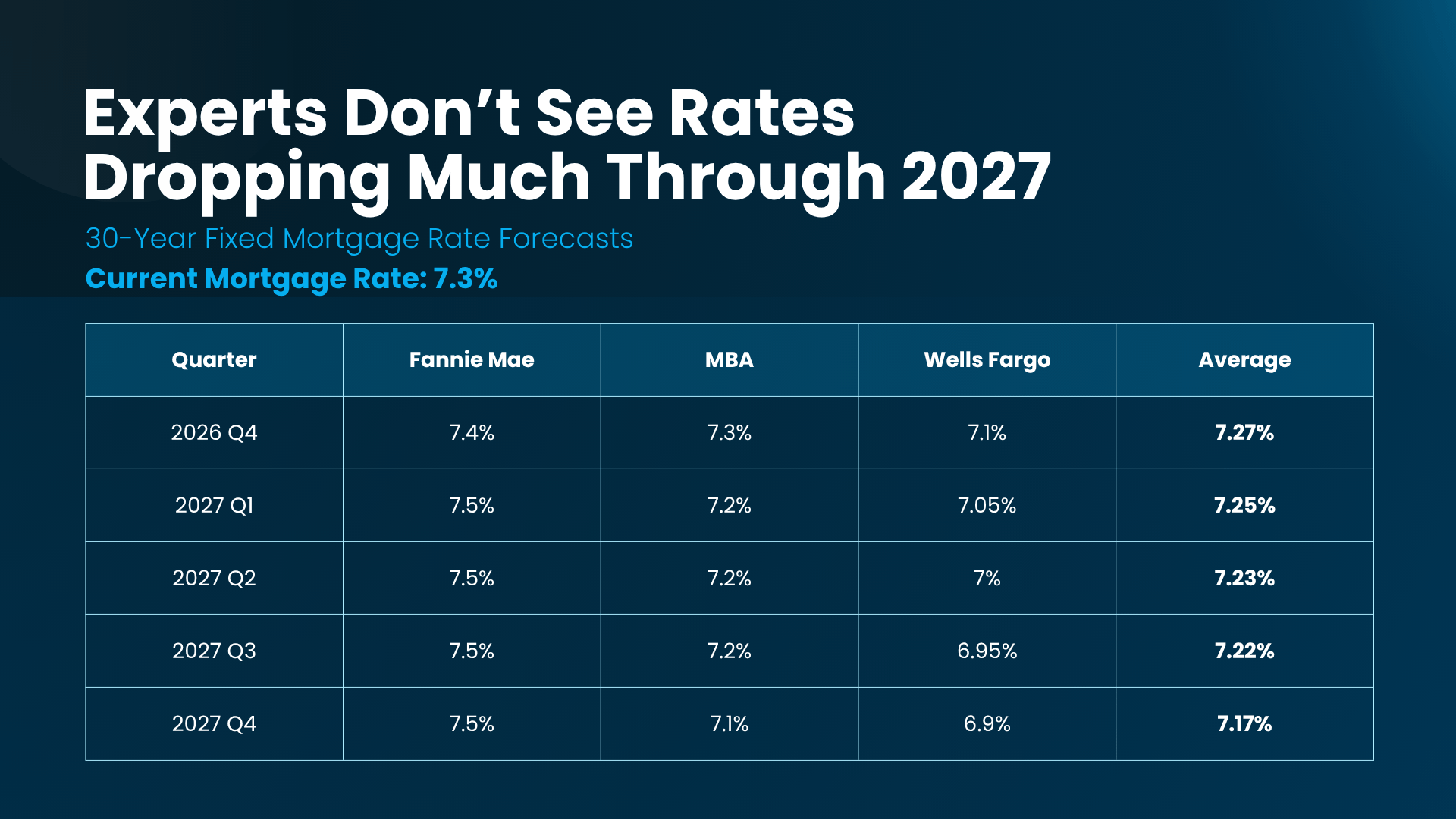
Sources: Fannie Mae, Mortgage Bankers Association, and Wells Fargo, as presented in the supplied November 2026 forecast comparison.
These projections suggest only modest movement in mortgage rates over the coming year.
For context, the average forecast declines from 7.27% in the fourth quarter of 2026 to 7.17% by the fourth quarter of 2027.
That's a difference of just 0.10 percentage points.
Of course, forecasts are estimates, not guarantees. Actual mortgage rates can change based on inflation, economic conditions, bond market movements, and other financial factors.
The important takeaway is that waiting for a dramatic rate reduction may not produce the savings some buyers are expecting.
And there's another consideration.
If mortgage rates eventually fall enough to encourage more buyers to return to the market, competition could increase.
That could reduce some of the negotiating opportunities available today.
What Happens if You Wait for Lower Mortgage Rates?
Waiting to buy a home can make sense for many reasons.
You may want additional time to save for a down payment, improve your financial position, or determine which property best fits your needs.
Those are all valid considerations.
However, waiting solely for mortgage rates to decline involves several uncertainties.
If rates decrease, your potential monthly payment could improve, assuming the purchase price and other financing terms remain unchanged.
But lower rates could also encourage additional buyers to enter the market.
Depending on local inventory, that increased demand could result in more competition, stronger offers, and fewer opportunities to negotiate seller concessions.
On the other hand, if rates remain elevated and market conditions continue to favor buyers, negotiating opportunities could persist.
Neither outcome is guaranteed.
That's why a homebuying decision should be based on more than a prediction about future interest rates.
You should consider your current financial situation, housing needs, expected length of ownership, and the total cost of purchasing a property.
Buying a Home in The Woodlands: Why Local Market Conditions Matter
National housing reports provide valuable context, but real estate decisions happen at the local level.
The Woodlands is made up of distinct communities, each with its own housing inventory, property characteristics, and pricing patterns.
For example, market activity in Sterling Ridge may differ from what buyers experience in Alden Bridge, Cochran's Crossing, Creekside Park, or Grogan's Mill.
Even within the same community, negotiating opportunities can vary based on a property's condition, asking price, time on market, and competing listings.
That's where local market knowledge becomes especially valuable.
At The McClung Group, we help buyers understand the housing market in The Woodlands and the greater Houston area so they can make decisions based on current conditions rather than national headlines alone.
When evaluating a property, we look beyond its asking price.
We consider recent comparable sales, current competition, listing history, and other factors that may influence the seller's negotiating position.
This information helps you develop an offer strategy that reflects both the property's market value and your financial priorities.
Whether you're purchasing your first home, relocating to the area, or looking for a property that better fits your current lifestyle, understanding your options can help you approach the process with greater confidence.
How To Decide Whether Buying Now Makes Financial Sense
Before deciding whether to purchase a home in today's market, it's helpful to evaluate the entire financial picture.
Start by determining a monthly housing payment you're comfortable maintaining.
Remember that homeownership costs extend beyond mortgage principal and interest. Property taxes, homeowners insurance, applicable homeowners association fees, maintenance, and other expenses should all factor into your budget.
Next, evaluate your available cash for a down payment, closing costs, and post-purchase reserves.
Then, compare potential properties based on their overall value rather than focusing exclusively on mortgage rates.
A home with a slightly higher interest rate but favorable purchase terms may be worth considering alongside a property with different pricing and financing arrangements.
However, a seller concession doesn't automatically make a home affordable or financially advantageous.
Every offer should be evaluated carefully, and you should understand the long-term costs before committing.
Most importantly, avoid making a purchase based on the assumption that refinancing will be available at a lower rate later.
Refinancing may become an option in the future, but eligibility, costs, and available interest rates will depend on circumstances at that time.
Your home purchase should make financial sense based on the terms available when you buy.
Final Takeaway: The Best Opportunity Isn't Always the Lowest Rate
When it comes to buying a home, mortgage rates are important, but they're only one part of the equation.
The low-rate environment of 2020 and 2021 offered attractive financing, yet buyers often faced intense competition and limited negotiating flexibility.
Today's higher-rate environment presents a different set of challenges and opportunities.
With more metropolitan markets leaning toward buyers and seller concessions becoming increasingly common, qualified homebuyers may have additional ways to negotiate a purchase that works for their budget.
That doesn't mean buying now is the right decision for everyone.
It means that waiting for lower mortgage rates shouldn't be your only consideration.
The right time to buy is when you find a home that meets your needs, the numbers work for your finances, and you're comfortable with the commitment.
Explore Your Homebuying Options With The McClung Group
Thinking about buying a home in The Woodlands, Spring, Conroe, Magnolia, or the surrounding greater Houston area?
At The McClung Group, we can help you evaluate available properties, understand local market conditions, and identify opportunities where sellers may be open to negotiating on price or other contract terms.
Whether you're ready to begin your search or simply want to understand what today's market could mean for your next move, we're here to help you make an informed decision.
Contact The McClung Group today to schedule a conversation about your homebuying goals.